EU ends EES border flexibility measures, raising fears of airport queue chaos across Europe
Why It MattersThe episode shows that border-technology rollouts shift bottleneck risk onto airports and airlines, since checkpoint capacity, not policy intent, ultimately sets passenger throughput.
What happened
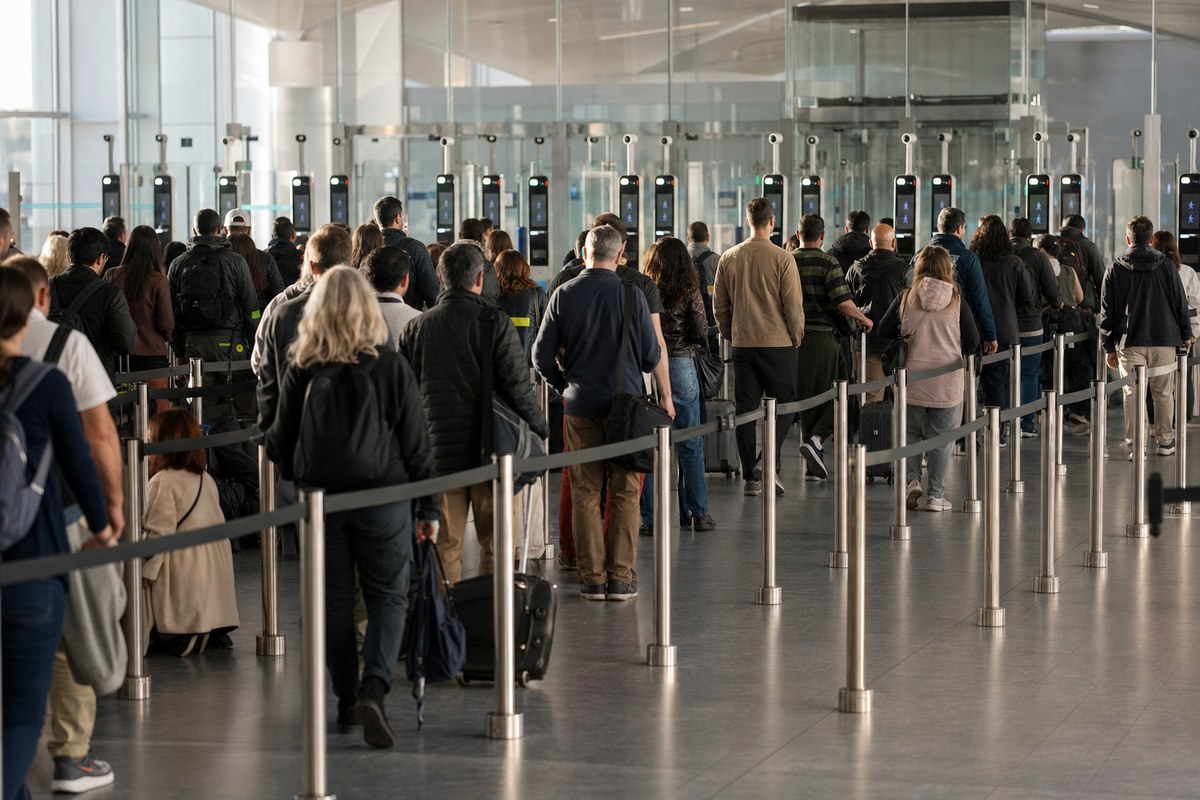
The European Union ended emergency flexibility measures for the Entry/Exit System (EES) on September 7, 2026, stripping individual member states of the authority to temporarily suspend biometric data collection — facial scans and fingerprints from non-EU passengers — when terminal queues surge. The EES reached full operational status on April 10, 2026, after a phased rollout that began in October 2025, replacing manual passport stamps with automated checks that record entries, exits, and biometric data in a centralized database. The suspended transition rules had been designed as a buffer while airports adjusted operations.
A European Commission spokesperson said on September 1, 2026, that the system "broadly worked well over the summer," adding that authorities remain in contact with "those few member states where some adjustments are needed at certain border crossing points." Thomas Reynaert, Senior Vice President of External Affairs at IATA, called an extension of partial suspensions "absolutely necessary until the end of the winter season," arguing that self-service kiosks, automated gates, and border staffing must be fully deployed first. Luke Petherbridge, Director of Public Affairs at UK travel trade association ABTA, confirmed the group continues to lobby the Commission to retain the waiver.
IATA data shows standard passport reviews now average 90 seconds under the digital process, compared with 20 to 25 seconds previously. Research by the Financial Times and analytics firm Qsensor found July 2026 checkpoint wait times reached 120 minutes at Frankfurt, double the 60 minutes recorded in July 2025. Amsterdam's maximum border queue rose from 80 to 120 minutes over the same period, while Munich's average queue time climbed from 31 minutes to 60 minutes — surges that occurred while member states still retained the right to suspend data collection. Jurgen Himmelmann, co-founder and CEO of Global Work & Travel, warned travelers to build substantial extra time into itineraries and avoid tight connections, noting that airline bag-drop counters typically stay closed until four hours before departure, leaving passengers no way to bypass an overwhelmed passport queue once in line.
Industry impact & what to watch
This is a case of a continental-scale identity system being switched on before the physical infrastructure around it — kiosks, automated gates, staffing — caught up, and the removal of the suspension safety net now tests that gap directly. Individual EES transactions running three to four times slower than the manual checkpoints they replaced is not a temporary glitch; it is the baseline the system was built on, and queue growth at Frankfurt, Amsterdam and Munich occurred even while suspensions were still legally available.
Border processing capacity behaves like any other fixed-infrastructure bottleneck: when per-passenger service time roughly quadruples and staffing or e-gate deployment does not scale with it, the queue absorbs the difference, and that queue sits upstream of everything airlines and airports control, including bag-drop and boarding timing. Trade bodies like IATA and ABTA are pushing for a policy lever precisely because the operational levers — more kiosks, more staff — take longer to deploy than a single season allows.
The determining factor over the coming winter is whether the Commission responds to the member states it has acknowledged need adjustments at certain crossing points, or holds the line through the higher-traffic season. IATA's own framing — that suspensions are needed "until the end of the winter season" — marks the next natural checkpoint for that decision.