Evident's NORTEC 700 Eddy Current Flaw Detector Combines Conventional and Array Inspection in One Instrument
Why It MattersMerging conventional and array eddy current inspection into one handheld unit points to consolidation of aerospace NDT equipment, where shops may need fewer separate instruments and less operator retraining.
Evident's NORTEC 700 Eddy Current Array Flaw Detector lets technicians switch between conventional eddy current testing (ECT) and advanced eddy current array (ECA) on a single platform, using the same interface. According to Michaël Barbeyrol, Evident's Senior Product Manager for Eddy Current and Bond Testing, this preserves setup continuity and removes the need for separate instruments.
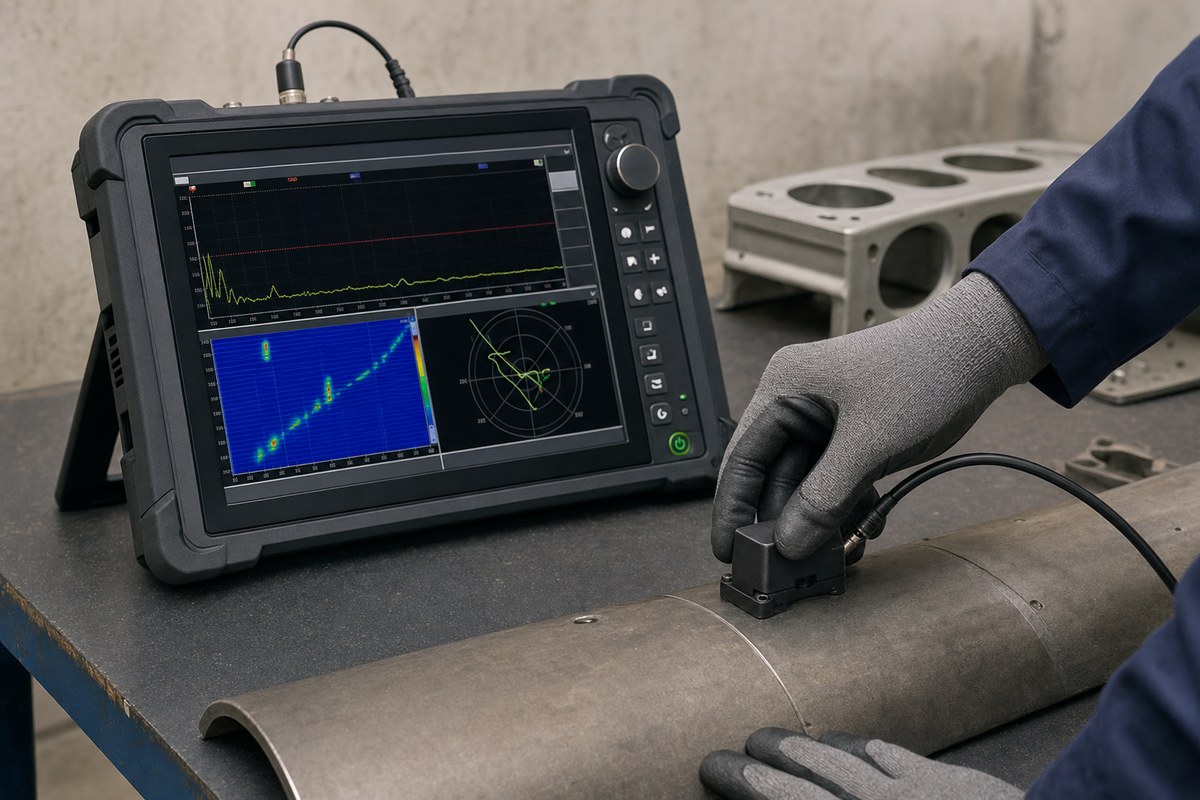
The platform introduces a new generation of eddy current array probes with a redesigned body for better ergonomics, an embedded encoder for legacy compatibility, a configurable remote switch and a wedge concept that reduces sensitivity while increasing application flexibility. Barbeyrol said the PCB-based probes offer repeatability, uniform signal quality from probe to probe and simple calibration, and that advanced users can design custom wedges for different geometries. The unit supports both legacy NORTEC 600 accessories and probes and the new array probes.
Barbeyrol said the interface evolves from the NORTEC 600, with common tasks such as loading presets, adjusting gain or reviewing signals needing fewer key presses, which he said speeds setup, reduces error potential and lowers operator fatigue. For aerospace use, he cited single- or dual-frequency ECT, conductivity and bolt-hole inspections on aircraft skin. Onboard storage records inspection snapshots, setup parameters and signal data directly on the detector, without extra hardware.
The NORTEC 700 comes in three models: the N700 (ECT), the N700D (dual-frequency and bolt-hole inspections) and the N700i (ECA, ECT and layer detection). Application-based presets automatically configure key parameters for selected probes and inspection types such as bolt hole, rivet line or surface crack, which Barbeyrol said reduces setup time to seconds and helps ensure consistency across operators and shifts. He described the N700 as covering standard ECT tasks such as conductivity testing, surface crack detection and small-component evaluation.