Scope Clauses Keep Embraer E175 at About 80% of US Regional Jet Market, Blocking E2 Successor
Why It MattersContract-set aircraft limits, not manufacturer innovation, fix the product mix in US regional flying, so the same ceiling that protects the E175 also blocks any successor from entering the segment.
What happened
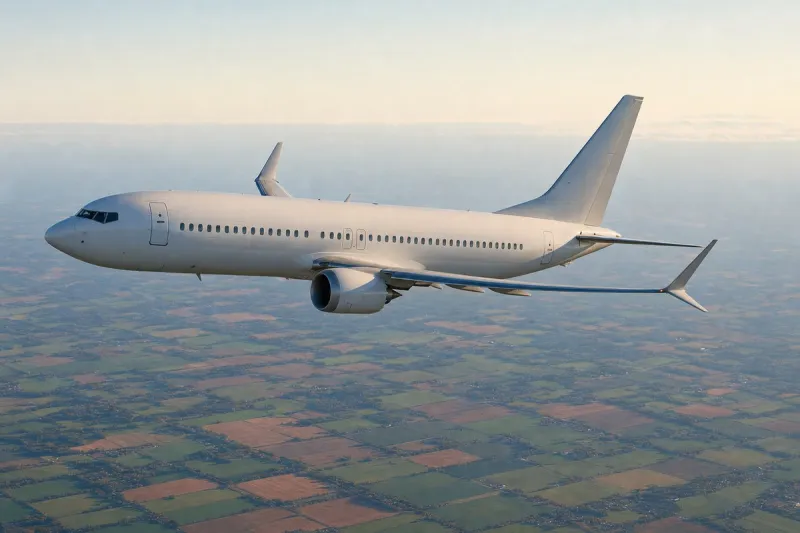
The Embraer E175, which first flew more than two decades ago, holds approximately 80% of its regional jet class and links hundreds of small US communities to the wider airline network. Much of that dominance comes from "scope clauses" in the pilot agreements at American, Delta and United Airlines. Those clauses limit the aircraft partner airlines can fly under the major brands to 76 seats and a maximum takeoff weight of 86,000 lb (39,009 kg). The E175 sits just inside both limits; Embraer's newer E2 version does not.

Most US airlines configure the E175 with 76 seats: 12 in first class and 64 in the main cabin, in a two-by-two layout with no middle seats. American Airlines partners with Envoy Air to fly the type to 174 airports across 43 states. SkyWest Airlines, Republic Airways and Envoy Air operate it as a feeder from small airports to hubs, where large narrowbodies such as the Boeing 737 or Airbus A320 would be too costly and hard to fill.
Numerical caps apply as well. According to AeroXplorer, United may outsource no more than 255 aircraft with 51 to 76 seats, and no more than 153 of those may have 76 seats. American's regional jets over 65 seats are capped at 40% of its narrowbody fleet, a ceiling of roughly 320 aircraft. Air Insight reported that the limits at all three carriers have been essentially unchanged since 2012, even though the pilot contracts were updated in 2023.
Competing programs, including Bombardier's CRJ series and Mitsubishi's SpaceJet, have been canceled or shut down, leaving no other 50-to-80-seat regional aircraft in production that complies with US scope clauses. The E175-E2, with larger geared turbofan engines and a new wing, drew virtually no initial customers because US airlines cannot fly it, and Embraer has extended its development pause, pushing any restart or entry into service to 2029 or later. Last year, American Airlines placed an order for 90 E175s, with options on 43 more.
The Government Accountability Office reports that regional airlines operated one-third of all domestic US flights in 2024 but carried just 14% of passengers. Between 2000 and 2018, departures from regional fields dropped 32% and non-hub airport departures fell 47%; GAO audits from 2018 through 2023 found traffic continued to fall while seats per flight rose. Regional airlines nearly doubled starting first officer pay from $52 an hour in 2021 to $93 an hour by 2024 to retain pilots. More than half of all currently certified pilots will reach the mandatory retirement age of 65 within 20 years.
Industry impact & what to watch
The E175's position shows how much of the US regional market is set by labor contracts rather than by aircraft engineering. When the pilot agreements at three major carriers fix the same seat and weight ceiling, the manufacturer's room to improve the product is bounded by a number negotiated between airlines and their pilots. A more efficient successor can exist on paper and still have no US customer, which is what the E175-E2's lack of initial orders illustrates.
That structure also explains why the large new order matters more than a typical fleet renewal. With the competing CRJ and SpaceJet programs gone, the airlines' realistic choice for regional capacity is a single in-production type from a single manufacturer. Pricing power and delivery slots in this class therefore sit largely with Embraer, while the carriers' leverage lies in the volume they commit.
The contract timeline is the thing to follow. The pilot agreements were updated in 2023 without moving the limits, so the next negotiating cycle is the point at which a change to 76 seats or 86,000 lb could appear. A change there would matter more to the E2's US prospects than anything Embraer announces about restarting development, which has already slipped to 2029 or later. The GAO's findings on falling regional departures and the pilot-pay increases add cost pressure on whichever aircraft ends up flying these routes.