Santa Barbara Airport Opens Draft Climate Adaptation Plan to Public Comment Through Nov. 13, 2026
Why It MattersCoastal airports built on low-lying wetland margins face flood exposure that shifts from occasional disruption to a recurring operating constraint, pushing sponsors to pair infrastructure protection with habitat obligations and regulator-linked funding.
What happened
Santa Barbara Airport (SBA) has released its draft Climate Adaptation Plan (CAP) for public review and is accepting community feedback by email at SBA_CAP@SantaBarbaraCA.gov through November 13, 2026.
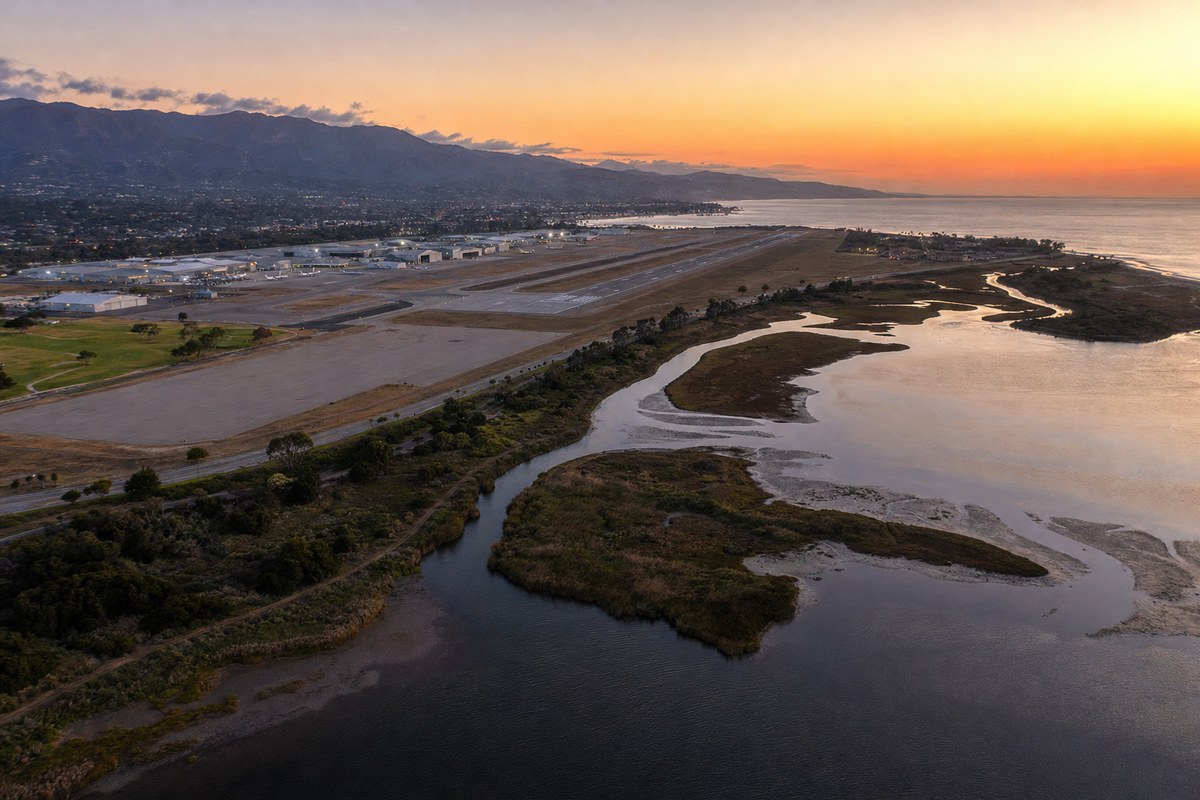
The plan sets out an approach to protect the airport and surrounding coastal resources from climate hazards including sea level rise and severe flooding. It prioritizes multi-benefit solutions that safeguard aviation infrastructure while protecting and enhancing the wetland habitats of the Goleta Slough.
The airport sits in a low-lying location near the Goleta Slough and is highly vulnerable to flooding. The current annual risk of a flood-related closure is 20%, projected to rise to 60% by 2076. Last winter, SBA experienced three separate closures due to severe flooding. Airport Director Chris Hastert said flooding at the airport is a current reality that requires immediate action, and that the plan provides a roadmap to protect infrastructure while serving as a responsible steward of the local environment.
Three-phase planning effort and funding
The planning effort runs in three phases. Phase I, a climate change and sea level rise hazards analysis and vulnerability assessment, has been completed. Phase II, the current phase, develops the Climate Adaptation Plan by identifying and evaluating flood protection strategies that balance nature-based solutions with traditional infrastructure.
The CAP is jointly funded by the California Coastal Commission and the City of Santa Barbara. In the third phase, the City will update its Airport and Goleta Slough Coastal Land Use Plan to incorporate adaptation-related policies.
SBA is owned and operated by the City of Santa Barbara and has provided commercial and general aviation services to the Tri-County region for more than 80 years. Alaska, American, Delta, Southwest and United serve the airport, with daily nonstop flights to 13 domestic destinations. It handles more than 1.4 million passengers each year.
Industry impact & what to watch
A move from a 20% to a 60% annual closure probability changes what flooding is for an airport. At 20%, closures can be absorbed as an occasional disruption; at 60%, they become a planning assumption that shapes schedule reliability, airline recovery plans and the case for capital spending. Three closures in a single winter show the exposure is already operational and not only a long-range projection.
The plan's structure reflects how coastal airports on wetland margins generally have to proceed. Flood protection that ignores adjacent habitat invites regulatory friction, so pairing nature-based measures with conventional engineering, and funding the work jointly with a coastal regulator, is a way to align protection of runways and terminals with environmental obligations. Airports with comparable low-lying footprints face the same trade-off between hardened barriers and restored natural buffers.
The next milestones are the close of public comment on November 13, 2026, and the City's later update of its Airport and Goleta Slough Coastal Land Use Plan, which is where adaptation policies would take binding form.