FAA: Part 91 Pilots May Use Custom Checklists on Check Rides If They Accurately Reflect AFM Procedures
Why It MattersThe clarification underscores that FAA checklist approval requirements apply only to Part 121 and Part 135 operators, leaving Part 91 training and testing dependent on AFM accuracy rather than agency sign-off.
What happened
A pilot training for a multiengine commercial certificate at a Part 61 school, flying a 1959 Beech Travel Air, asked whether a personally created, laminated checklist could be used on an FAA practical test. The checklist had been compiled from the aircraft's owner's manual and its serial-number-specific Airplane Flight Manual (AFM). The pilot's Multi-Engine Instructor (MEI) had warned that the checklist was not FAA-approved and that a Designated Pilot Examiner (DPE) would fail the applicant for using it.
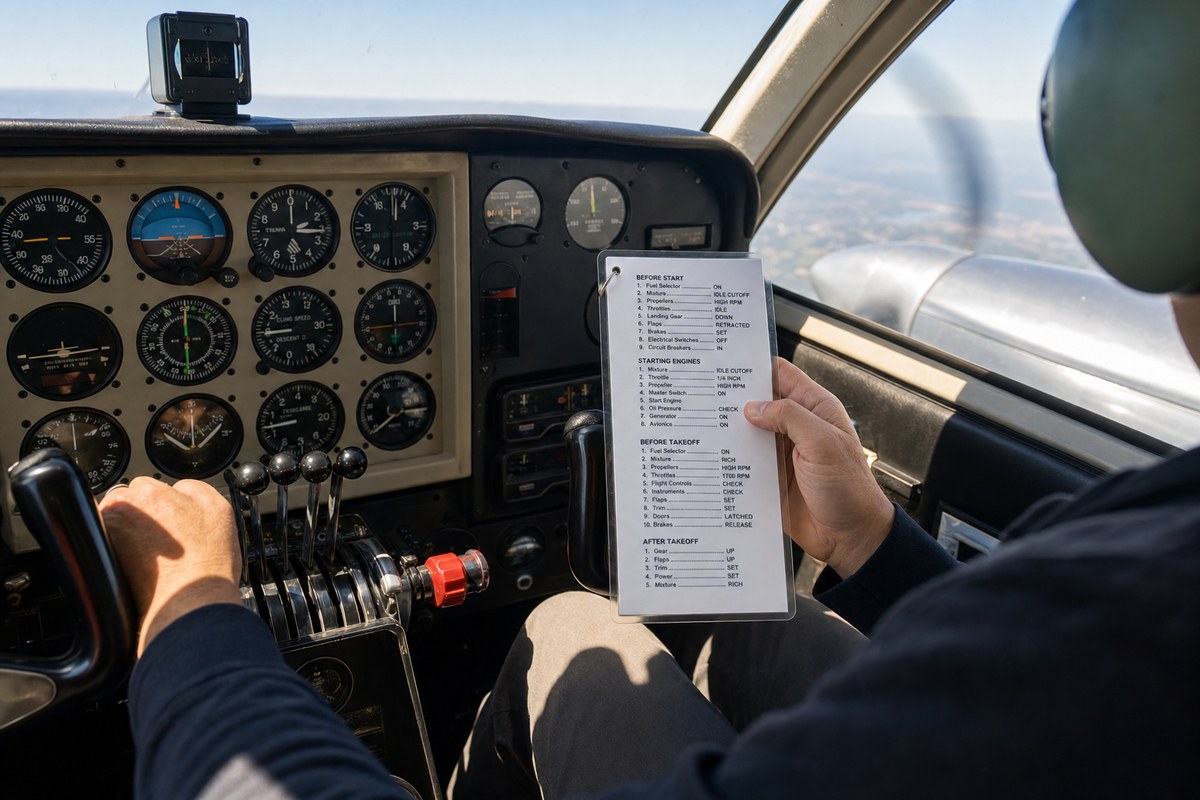
The FAA's stated policy does not support that warning. The agency says it does not approve general aviation pilot checklists, and that pilots are instead required to operate aircraft in accordance with the operating limitations specified in the approved AFM, Rotorcraft Flight Manual (RFM), cockpit markings, and placards. Checklist approval is required only for Part 121 and Part 135 operators, who must submit cockpit checklists to the agency as part of their approved operating manuals.
For practical tests conducted under Part 91, the FAA's Airman Certification Standards (ACS) and Practical Test Standards (PTS) require applicants to use an appropriate checklist. Those standards explicitly permit manufacturer-supplied checklists, commercial off-the-shelf checklists, or personally developed checklists, provided a personally developed checklist accurately reflects the operating limitations and procedures contained in the aircraft's AFM or RFM.
Industry impact & what to watch
This case reflects a recurring gap between what instructors tell applicants and what FAA policy actually requires: checklist approval is a Part 121/135 operating-manual obligation, not a Part 91 one. Under Part 91, the checklist itself is not the object of scrutiny; its fidelity to the AFM or RFM is.
For flight schools and DPEs, this means the practical test standard is accuracy against the approved flight manual, not the source or format of the document — a manufacturer checklist, a commercial off-the-shelf product, and a personally developed list all qualify equally as long as they match AFM procedures and limitations. Instructors who tell applicants otherwise risk creating unnecessary anxiety or steering them toward checklists that are less tailored to older or unusual airframes, such as a 1959 type with a serial-number-specific AFM.
Whoever administers the next practical test on this airframe will be the one to confirm whether the laminated checklist holds up against the AFM's actual procedures and limitations — that comparison, not FAA sign-off, is what the ACS and PTS actually test.