Turkey's Hürjet First Production Aircraft Completes 18-Minute Maiden Flight
Why It MattersMoving from prototype to production-configuration flight testing signals a trainer program nearing operational deployment, a step that also underpins export commitments such as Spain's 30-unit order.
What happened
The first production Hürjet advanced jet trainer built for the Turkish Air Force completed its maiden flight on August 30, 2026, staying airborne for 18 minutes. The flight followed completion of final assembly, ground testing, and taxi tests, marking the start of flight testing for an aircraft built in the configuration intended for operational delivery.
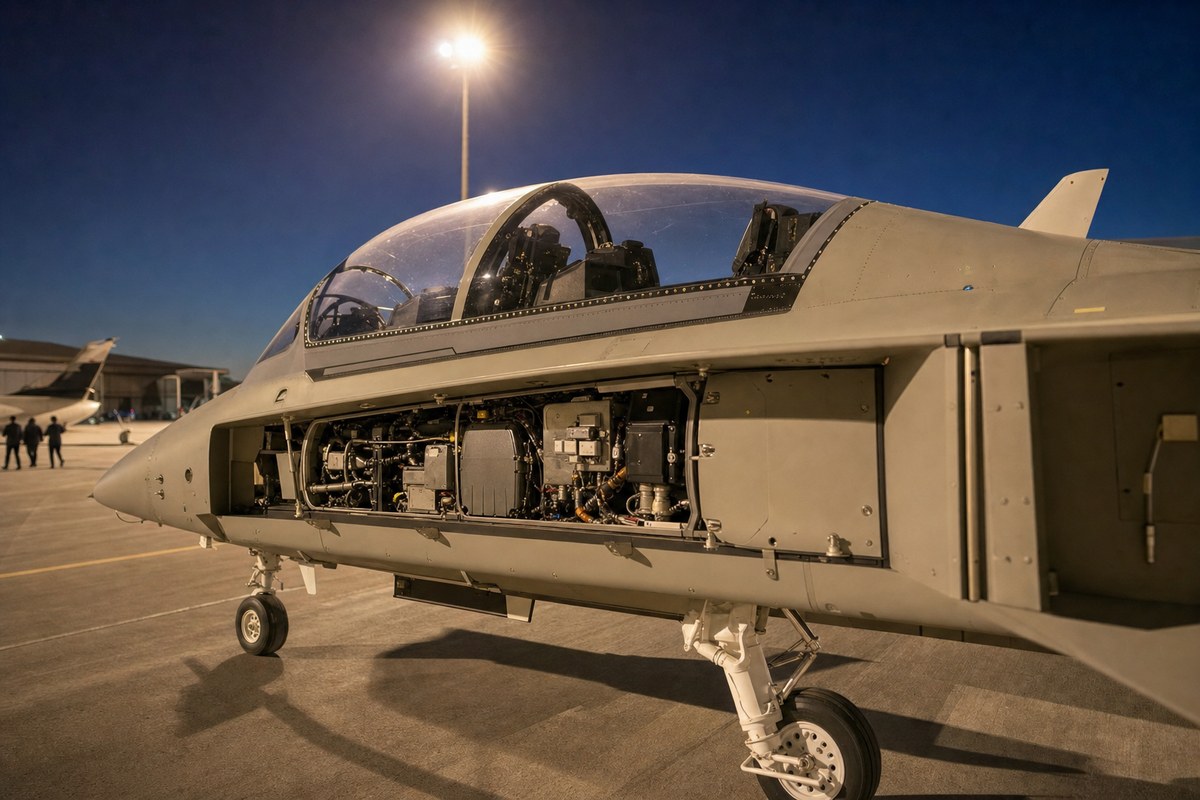
Developed by Turkish Aerospace, the Hürjet is a single-engine, tandem-seat supersonic aircraft designed for advanced and lead-in fighter training as well as light combat missions. It is powered by a General Electric F404 afterburning turbofan producing approximately 17,700 pounds of thrust, giving it a maximum speed of Mach 1.4, a service ceiling of 45,000 feet, and a published range of 1,060 nautical miles. The aircraft is rated to withstand +8g and -3g loads and can carry up to 7,500 pounds of external payload.
The Hürjet program was launched in 2017, with the first prototype making its maiden flight on April 25, 2023. Two prototypes have been used in the flight-test campaign, including testing of transonic and supersonic performance. Production aircraft are now being assembled in the configuration planned for Turkish Air Force service, and the first production aircraft will undergo further flight testing and verification before delivery.
For the Turkish Air Force, Hürjet is intended to replace the ageing T-38 fleet used for advanced jet training and has also been associated with a potential replacement for the F-5 aircraft operated by the Turkish Stars aerobatic team. Spain has selected the aircraft as part of its new combat training system and plans to acquire 30 units to replace its ageing F-5 training fleet, with Airbus working alongside Turkish Aerospace on the Spanish program and deliveries planned from 2028.
Industry impact & what to watch
A trainer program's credibility rests on the gap between a prototype flying and a production-standard airframe flying, since only the latter proves the manufacturing and configuration line that customers actually receive. The Hürjet's shift from two prototypes used for transonic and supersonic testing to a production-configuration aircraft now beginning its own flight-test and verification cycle is the milestone that lets an air force and an export customer plan around real delivery dates rather than developmental ones.
Advanced jet trainer competitions increasingly hinge on this kind of proof point: Spain's commitment to 30 units alongside Airbus's involvement in the program shows how export sales can be locked in before a production aircraft has completed its own flight-test regime, provided the underlying development aircraft have already demonstrated the performance envelope. That sequencing puts weight on the Turkish Air Force's own T-38 replacement timeline and the Spanish 2028 delivery target as the next dates against which the program's progress will be measured.
What happens next is whether the first production aircraft's flight-test and verification campaign clears in time to support both the domestic delivery schedule and the Spanish program's 2028 start.