Gogo Unveils Road Map Extending Galileo Satellite Service Into the 2030s, With Speeds Up to 1.5 Gbps by 2032
Why It MattersPairing a fixed antenna installation with scheduled speed upgrades and three-year price locks shifts inflight connectivity toward long-lived infrastructure whose value rests on the satellite operator's constellation plans, not hardware refresh cycles.
What happened
Gogo, the Broomfield, Colorado-based inflight connectivity provider, has announced a long-term road map for its Galileo satellite broadband service that extends the value of investing in the system into the mid-2030s. Gogo rolled out Galileo in 2025, adding to its terrestrial air-to-ground cellular services. Galileo uses the Eutelsat OneWeb constellation of about 650 first-generation, primarily Ku-band satellites in low Earth orbit.

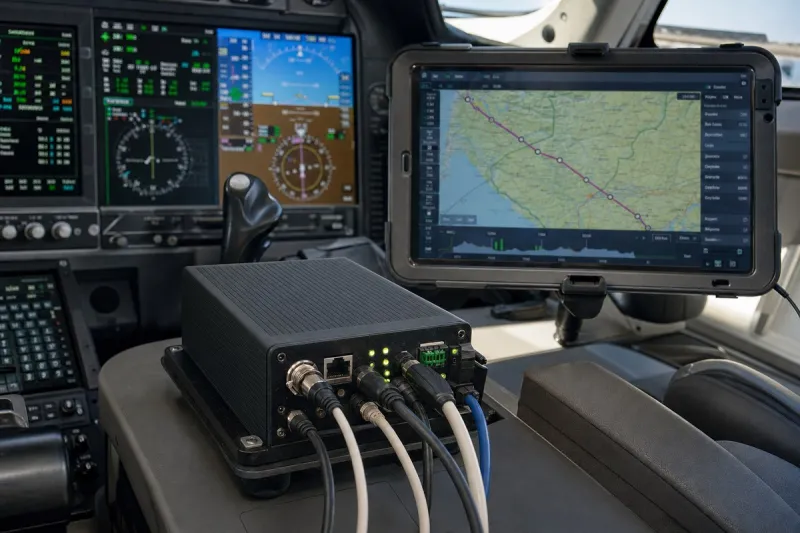
Gogo and partner Hughes Network Systems supply two fuselage-mounted, flat-panel, electronically steerable antenna terminals: the half-duplex (HDX) for light-to-midsize jets and turboprops, and the full-duplex (FDX) for super-midsize and larger business jets. A half-duplex antenna can transmit or receive data only at a given moment, while a full-duplex antenna can do both simultaneously. Gogo says it has designed an upgrade path for both terminals that preserves as much of the existing installation infrastructure as possible, including antenna mounts, fairing and wiring.
Current download speeds are 60 megabits per second (Mbps) on the HDX terminal and 195 Mbps on the FDX. Gogo CEO Christopher Moore said customers are investing in the product's form factor and STC installation, which will not change into the 2030s. He said equipment or software upgrades will raise speeds in two-year increments, reaching 300 Mbps on the HDX and 1.5 gigabits per second on the FDX by 2032.
The road map aligns with Eutelsat's satellite plans, which include the commercial IRIS² network, expected to be operational in the early 2030s. Eutelsat is supplying the low-Earth-orbit component of the multi-orbit European Union constellation: 264 dual military Ka-band/commercial Ku-band satellites and 66 military Ka-band satellites.
Pricing and guarantees
Gogo also offers three-year guaranteed pricing for Galileo subscriptions. A 25-GB monthly data plan with the HDX antenna costs $3,500 per month for three years, and a 50-GB plan with the FDX antenna is price-locked at $7,000 per month for three years.
Three-year unlimited plans cost $10,500 monthly for HDX and $12,500 for FDX.
Industry impact & what to watch
Business-aviation connectivity has long been bought like avionics: a hardware installation with a service plan on top, and a refresh whenever the network outgrows the box. Gogo's road map argues for a different model, in which the fuselage installation stays fixed and performance rises through software and equipment upgrades staged every two years. For owners and operators, the asset being paid for becomes the STC-approved installation, while the speed experienced in flight depends increasingly on the satellite operator behind it.
That dependence ties the road map to Eutelsat's schedule. Gogo's 2032 speed targets sit alongside the IRIS² network, expected to be operational in the early 2030s, so the later steps of the road map rely on that constellation arriving on its stated timeline. Three-year price locks soften the cost side of that exposure for subscribers, but the performance side still hinges on the satellite plans.
The next milestones to track are the first of the two-year upgrade steps on the HDX and FDX terminals, and progress toward IRIS² operations in the early 2030s. Those will show whether the preserved mounts, fairing and wiring really carry customers to the 300 Mbps and 1.5 Gbps targets without a new installation.