Luton Airport's Hidden Noise Fines Catch Business Jet Operators Off Guard
Why It MattersBecause Luton's noise-fine regime sits outside the AIP and no NADP is mandated, crews are left to self-impose steep-climb profiles informally to avoid monitor triggers that formal compliance does not prevent.
What happened
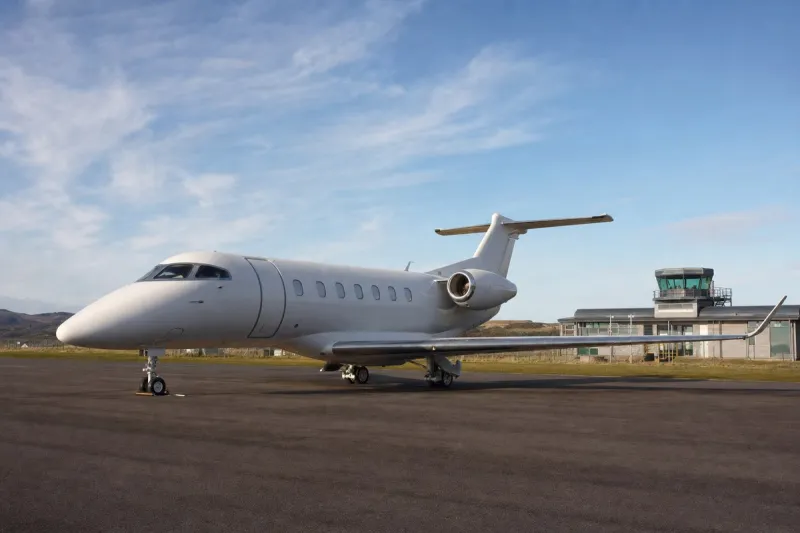
A business jet operator was fined £1,250 ($1,700 USD) after a Dassault Falcon 7X departed London Luton Airport (EGGW) and exceeded the airport's daytime noise limit of 79 dB by 0.6 decibels, recording 79.6 dB. The aircraft was operating near maximum take-off weight on a warm summer day. The crew had flown the published Noise Preferential Route (NPR) and met the only climb requirement stated in the UK AIP — a minimum of 500 feet per minute — yet still triggered the fine.

When the operator queried the fine, the airport authority provided flight data showing the noise event was recorded at approximately 2,900 ft, just 100 ft below the daytime 'release altitude' of 3,000 ft. The data also showed the flight was climbing at a shallower gradient than most other departures that day.
Luton does not publish a Noise Abatement Departure Procedure (NADP) and has confirmed it has no plans to mandate one, stating that 'individual airlines require different procedures.' The airport instead enforces noise limits through a network of noise monitoring terminals sited in surrounding suburbs. The monitoring programme and its fines are not listed in the AIP; they appear only in the airport's Charges and Conditions of Use document. Since January of this year, the limits have stood at 79 dB during the day and 78 dB at night, with a daytime fine of £1,250. The AIP's only additional noise guidance is a general instruction to climb at power settings that ensure progressively decreasing noise.
NADP 1 and NADP 2
ICAO defines two standard noise abatement departure profiles. NADP 1 prioritises reducing noise close to the runway by maintaining configuration and delaying power reduction. NADP 2 spreads noise reduction further from the airport through early acceleration and flap retraction. Neither is mandated at Luton, but the flight data the airport supplied suggests that applying one anyway — rather than flying the minimum AIP-stated climb gradient — is what keeps most departures below the monitors' thresholds.
Industry impact & what to watch
This case shows how a noise-fine regime can be technically compliant with published procedures and still expose operators to financial penalty, because the enforcement mechanism — ground-based noise monitors keyed to a release altitude — sits outside the document crews are trained to follow. The AIP tells a crew what climb rate satisfies the regulator; it says nothing about the altitude and gradient combination the airport's monitors actually measure against.
In this segment, business jet operators flying near maximum weight in warm conditions are the ones most exposed, since payload and temperature both erode climb performance relative to the fixed noise thresholds. Where an airport declines to mandate a NADP but still fines against undisclosed monitor thresholds, crews are effectively pushed to adopt steeper unofficial climb profiles as insurance, without the airport ever setting a shared standard.
What would change the picture is whether Luton publishes its release altitude and monitor siting alongside the AIP procedures, or whether it continues to leave that detail only in the Charges and Conditions of Use document that operators must separately seek out.