NTSB: Cirrus SF50 Nose Gear Collapses After Landing Gear Lever Selected UP During Rejected Takeoff in Mesa, Arizona
Why It MattersRejected-takeoff accidents like this show how a brief, ambiguous cue in a single-pilot jet can chain together control inputs and gear-state errors faster than the pilot can reconcile them.
What happened
The National Transportation Safety Board (NTSB) has published an accident report, dated November 2024, on a Cirrus SF50 accident at Mesa, Arizona. The pilot said that during the takeoff he heard an unrecognizable sound and aborted the takeoff roll. He applied the brakes and pulled the throttle back at the same time.
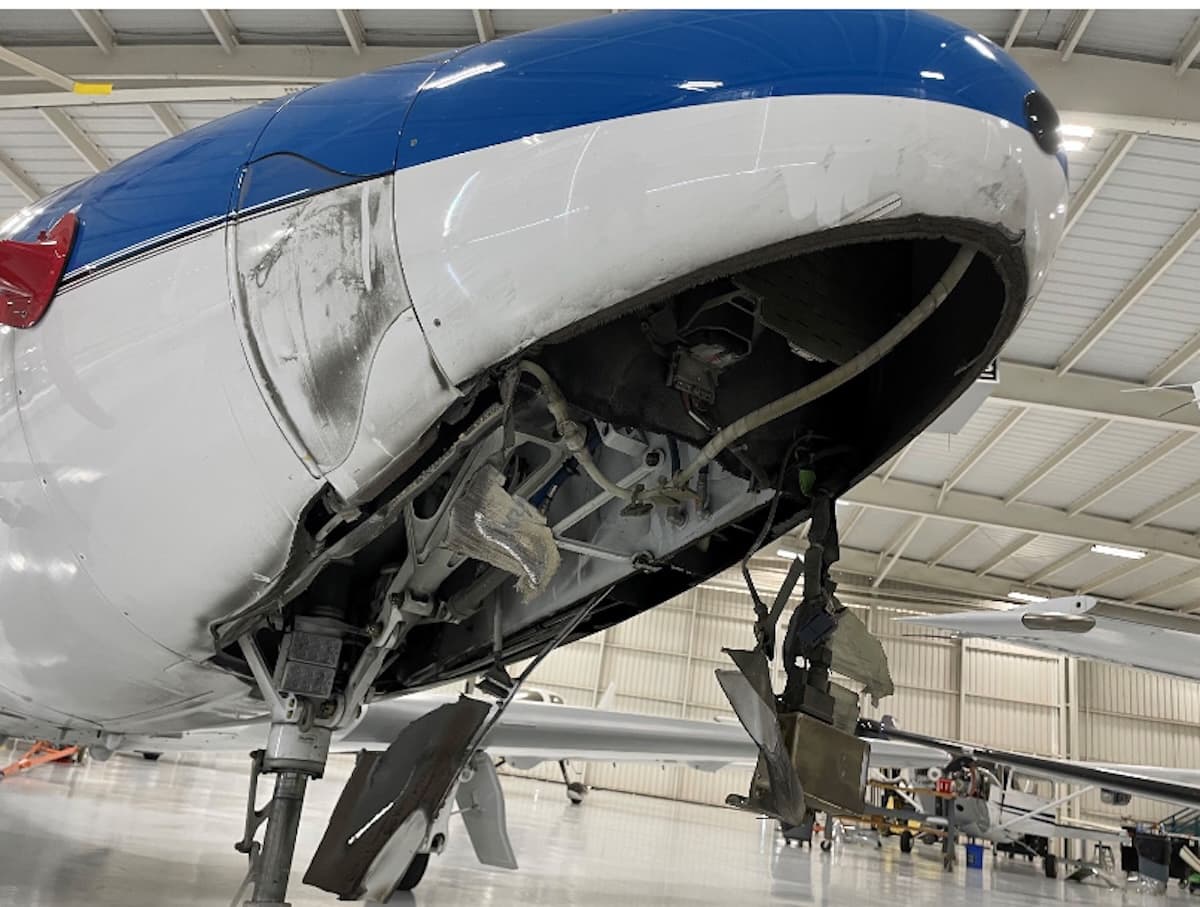
The airplane lifted off the ground and returned to the runway on its nose, collapsing the nose landing gear. The airplane's emergency procedures caution that the airplane might rotate and lift off the ground if the thrust lever is abruptly brought to IDLE prior to brake application.
A post-accident review of flight data from the airplane's Recoverable Data Module (RDM) showed that the landing gear lever was in the UP position during the takeoff roll, at a time when one of the weight-on-wheels (WOW) sensors showed the airplane as airborne. A few seconds later the WOW sensor reactivated and the airplane settled onto the nose gear, which was then in a transitory, unlocked position and collapsed. When the airplane came to rest, the landing gear lever was placed in the DOWN position.
The NTSB's probable cause was the pilot's improper landing gear selection during the takeoff roll and failure to maintain airplane control during a rejected takeoff, which resulted in abnormal contact with the runway and a collapse of the nose landing gear. The report is published as an educational tool intended to help pilots learn from the misfortunes of others.
Industry impact & what to watch
The sequence in this report ties together three things that happen within seconds: an unfamiliar sound, a simultaneous brake and throttle input, and a gear lever that ended up in the wrong position. In a single-pilot jet, a short-lived weight-on-wheels signal can be enough to put the gear system in a state the pilot did not intend, and the aircraft's own emergency procedures already warn that abrupt thrust reduction before braking can let it rotate and lift off.
For the light-jet segment, the lesson is about rejected-takeoff technique and gear-state awareness during high-workload moments, not about any one airframe. Training programs and recurrent checks that rehearse the abort sequence in the order the manufacturer specifies address exactly the gap the NTSB identified.
The NTSB frames the report as an educational tool for pilots, and the data from the Recoverable Data Module is what makes the gear-lever and sensor timeline reconstructable. The next signal worth following is whether the NTSB or the manufacturer publishes any further guidance tied to rejected takeoffs in this type.