Router Upgrade Fault Triggers 4-Hour-21-Minute U.S. Ground Stop, Not a Cyberattack
Why It MattersThe episode shows that modernization work on aging air traffic infrastructure can itself become the point of failure, and it strengthens the funding argument for replacing legacy communications equipment.
What happened
U.S. national airspace was shut down for 4 hours and 21 minutes on Friday. Flights already in the air were mostly diverted back to their points of origin, and planned departures were halted, with the exception of a few international flights.
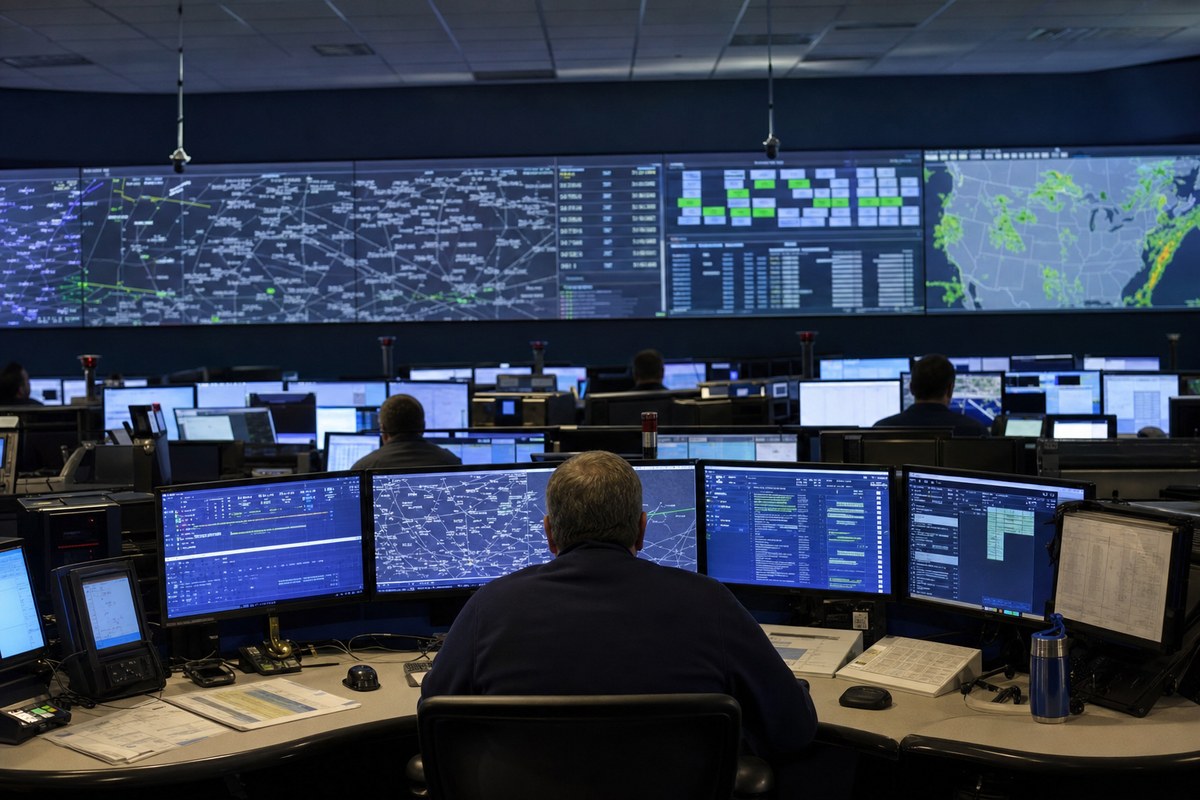
Federal officials determined the air traffic control system had become unsafe and unreliable after a router in El Dorado, Arkansas, sent a flood of data into the network following an upgrade. A second problem was detected at a facility in Texas. Both facilities were taken offline, but each had already pinged the communications network hundreds of times.
An L3Harris contractor was switching old copper wire to fiber while replacing a router. The new router flooded other routers with about 1,000 login attempts every four to five seconds, knocking over Cisco 600 series routers made between 2001 and 2006. Homeland Security Secretary Markwayne Mullin said officials had seen zero evidence of a cyberattack.
President Donald Trump blamed the Biden administration, writing that it had spent money unwisely, and called on Congress to provide funding quickly. Transportation Secretary Sean Duffy said contractors take government money and provide poor service, and that the $12.5 billion already provided for modernization is not enough.
Funding and legislation
The Department of Transportation has described the $12.5 billion already provided as a down payment on a $31.5 billion program.
The Modern Skies Act, introduced by Sen. Eric Schmitt (R-Mo.), would add another $30 billion, bringing the projected total to $42.5 billion.
Industry impact & what to watch
The disruption was not caused by the old system itself but by the effort to replace it. That distinction matters for how modernization is judged: cutover work on legacy hardware carries its own operational risk, separate from the age of the equipment being retired.
For airlines and business-aviation operators, a nationwide ground stop of this length propagates through crew duty time, aircraft positioning and slot availability well beyond the hours of the stoppage itself. The segment's exposure is to single points of failure in shared communications infrastructure, which no individual operator can mitigate.
The next concrete marker is whether Congress acts on the Modern Skies Act and its additional $30 billion, since that bill is the funding path the material names.