Fujairah Airport's Open-Sky, Low-Traffic Model Carves Out UAE MRO Niche
Why It MattersAs major Gulf carriers bring more heavy maintenance in-house, uncongested airports serving third-party and business aviation MRO work face less competition for scarce hangar space.
What happened
Fujairah International Airport (FJR) operates under an open-sky policy that requires no slot coordination, a setup the airport contrasts with the congested hubs that dominate the region. The airport runs a 12,300-foot runway and describes itself as offering unrestricted take-offs and landings, with a design capacity of approximately 2 million passengers annually — a figure it has never needed to approach. Dubai International Airport (DXB), by comparison, carried a record 95.2 million passengers in 2025 and is described by industry trackers as approaching its practical capacity ceiling of around 100 million.
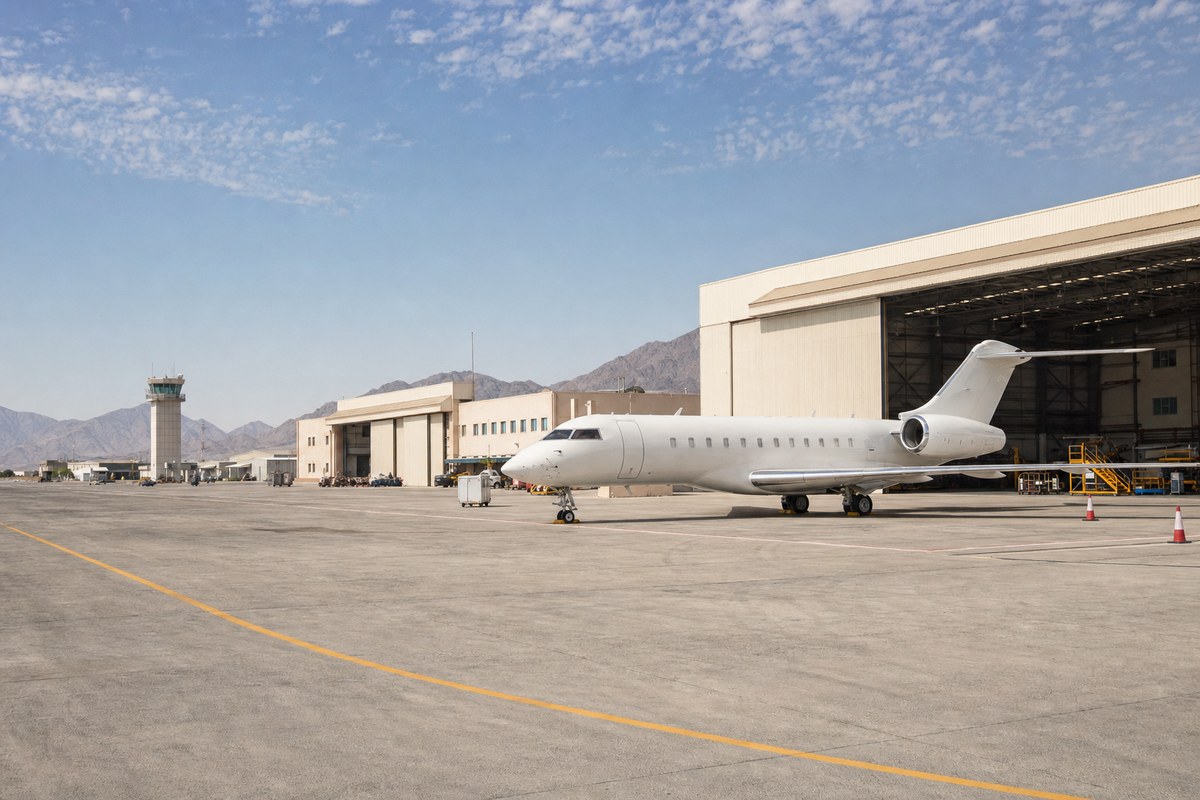
Jet Aviation, which has operated in the UAE since 1998, opened a dedicated maintenance facility in Fujairah in 2017, focused on Bell helicopter support and base and line maintenance for commercial and military operators across the Middle East. Industry directories list the airport as home to two FBO handlers, two maintenance providers, one charter operator, two in-flight catering firms and two aircraft cleaning companies. Charter brokers operating in the region identify more than 29 private aircraft available for on-demand charter within a 100-mile radius of Fujairah, with types including Learjet 60s, Hawker 800XPs, Legacy 600s, Challenger 604s, Falcon 900DXs and Gulfstream G300s among the most common.
Fujairah sits within a cluster of Northern Emirates airports: Ras Al Khaimah International is 37 nautical miles away, Al Saqr Field 43 nautical miles, and Sharjah International 46 nautical miles. Sharjah has also added dedicated business aviation capacity, with Gama opening a new Business Aviation Centre noted for rapid turnaround times and hangar capacity. The UAE's aircraft MRO market was valued at approximately $3.06 billion in 2025 and is forecast to grow at roughly 5.09% annually, reaching an estimated $4.33 billion by 2032, while the broader Middle East MRO market is estimated at around $10.55 billion, served by 25 to 30 tier-one providers and more than 100 large-scale facilities.
Major investment in the sector is concentrated in Dubai, including Emirates' $5.1 billion engineering complex at Dubai South and flydubai's 32,600-square-metre maintenance centre. Emirates Engineering operates 12 hangars supporting a fleet of 255 aircraft and provides contract maintenance for more than 30 outside airlines. Qatar Airways' facility can hold 12 aircraft simultaneously, including A380s, and Jazeera Airways has stated that maintenance accounts for close to 40% of its cost base. Analysts including Oliver Wyman have flagged a shortage of hangar space for airframe heavy maintenance across the Middle East and Europe as a constraint on sector growth.
Industry impact & what to watch
Fujairah's position illustrates a structural split opening up in Gulf aviation infrastructure: capacity-constrained mega-hubs concentrate widebody flying and headline MRO investment, while smaller, uncongested fields absorb the business aviation and specialist maintenance work that does not need a 12-million-passenger terminal next door. An open-sky airport with no slot coordination and a runway built for far more traffic than it carries becomes an asset precisely because the region's largest airports are running short of room.
The segment Fujairah serves — third-party and business aviation MRO, charter support, helicopter maintenance — depends on exactly the kind of unused capacity that Dubai and its peers no longer have. As Emirates, Qatar Airways and other major carriers bring more of their own widebody and narrowbody maintenance in-house, the hangar space that independent providers compete for tightens further, and Oliver Wyman's flagged shortage across the Middle East and Europe makes any spare slot, anywhere, more valuable.
Whether Fujairah's niche deepens will depend on whether more operators follow Jet Aviation's move and site dedicated facilities there, and on how quickly neighbouring fields like Sharjah — where Gama has just added its own Business Aviation Centre — draw the same overflow demand. The next signal will be whether new tenants announce facilities at Fujairah or at its Northern Emirates neighbors, rather than in Dubai's more crowded MRO cluster.