FAA Withholds Approved 2.8% Pay Raise for Air Traffic Controllers Amid Staffing Crisis
Why It MattersTying pay adjustments to productivity metrics during an acknowledged staffing shortfall shows how compensation and workforce policy can become entangled with operational performance targets in air traffic control.
What happened
The Federal Aviation Administration has yet to implement a 2.8% pay raise for air traffic controllers that Congress approved in April, even as the agency faces a shortage of approximately 3,000 controllers. Controllers report working shifts of up to ten hours, six days a week.
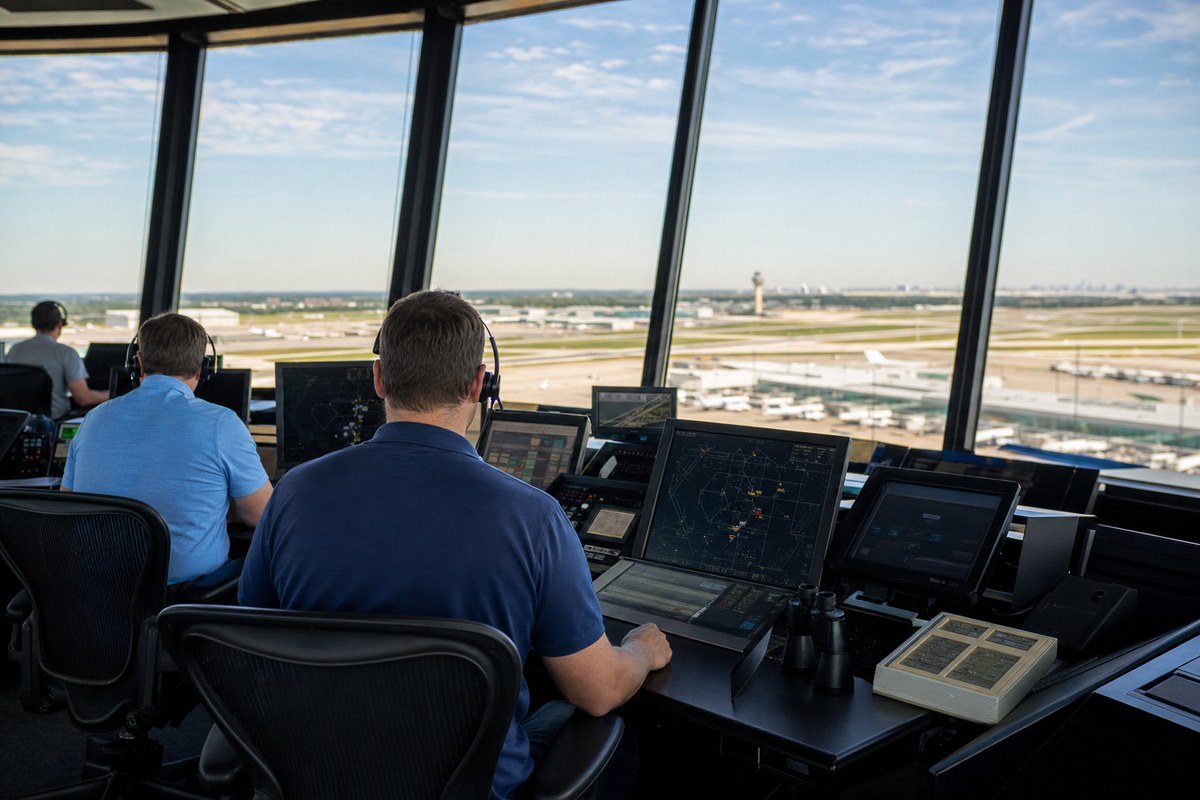
Congress approved funding in April to bring controllers' pay in line with a 3.8% increase previously awarded to military personnel. Controllers had already received a 1% raise issued to all federal employees in January, leaving the remaining 2.8% unimplemented. FAA Administrator Bryan Bedford has linked the remaining pay adjustment to conditions around operational improvements, while FAA spokesperson Hannah Walden stated that the statute gives the administrator discretion over whether the adjustment should be made retroactive to January. The FAA has argued that controllers are not being sufficiently productive to warrant the raise, pointing to internal data suggesting controllers averaged around four hours in an operational position during an eight-hour shift, and proposing that figure be increased to approximately five hours. The agency is also reviewing watch schedules and facility hours of operation to better match staffing with demand.
Retired air traffic controller Dave Riley, who worked at Denver International Airport (DEN) and Phoenix Sky Harbor International Airport (PHX), told the Washington Examiner that excessive overtime sustained over a long period, combined with training interruptions, has made it increasingly difficult to rebuild the workforce. Between 2023 and 2025, overtime levels at FAA facilities far exceeded what experts consider reasonable use, according to analysis cited in the reporting. Current controllers warn that chronic overtime is driving fatigue, burnout, and attrition, further complicating recruitment. At understaffed facilities, the absence of one or two controllers can force the FAA to limit the number of aircraft permitted in a given airspace, causing ripple delays across the national air traffic system.
Industry impact & what to watch
This case sits at the intersection of a funded legislative commitment and an agency's discretionary implementation authority, a gap that can persist even after Congress has acted. When a pay adjustment is conditioned on productivity metrics the agency itself defines, the metric becomes a lever separate from the appropriation, and workers absorb the interval between approval and payment.
Air traffic staffing runs on a tight loop: shortages push overtime, overtime drives fatigue and attrition, and attrition deepens the shortage the FAA is trying to solve by raising the productivity bar. A shortfall of a few controllers at a single facility can cascade into aircraft-number limits and delays felt well beyond that airspace, which is why staffing levels at individual facilities matter to the wider network rather than staying a local personnel issue.
What happens next depends on whether the FAA finalizes the operational-position benchmark it is proposing, at roughly five hours per eight-hour shift, and on how the agency ultimately treats retroactivity to January. Both decisions determine when, and for whom, the approved raise actually reaches paychecks.