Learjet 23 (1964–1966): The Aircraft That Created the Light Business Jet, With One Example Still Flying as of 2025
Why It MattersWhen an OEM abandons a legacy type, an aircraft's survival shifts entirely to independent parts stockists, teardown houses and volunteer-run restoration efforts rather than factory support.
What happened
The Learjet 23, produced between 1964 and 1966, was the aircraft that established the light business jet category, with 101 airframes built in three years. As of 2025, only one remains flyable — a hush-kitted 1965 example — while the rest serve as museum exhibits, restoration projects, or parts donors.
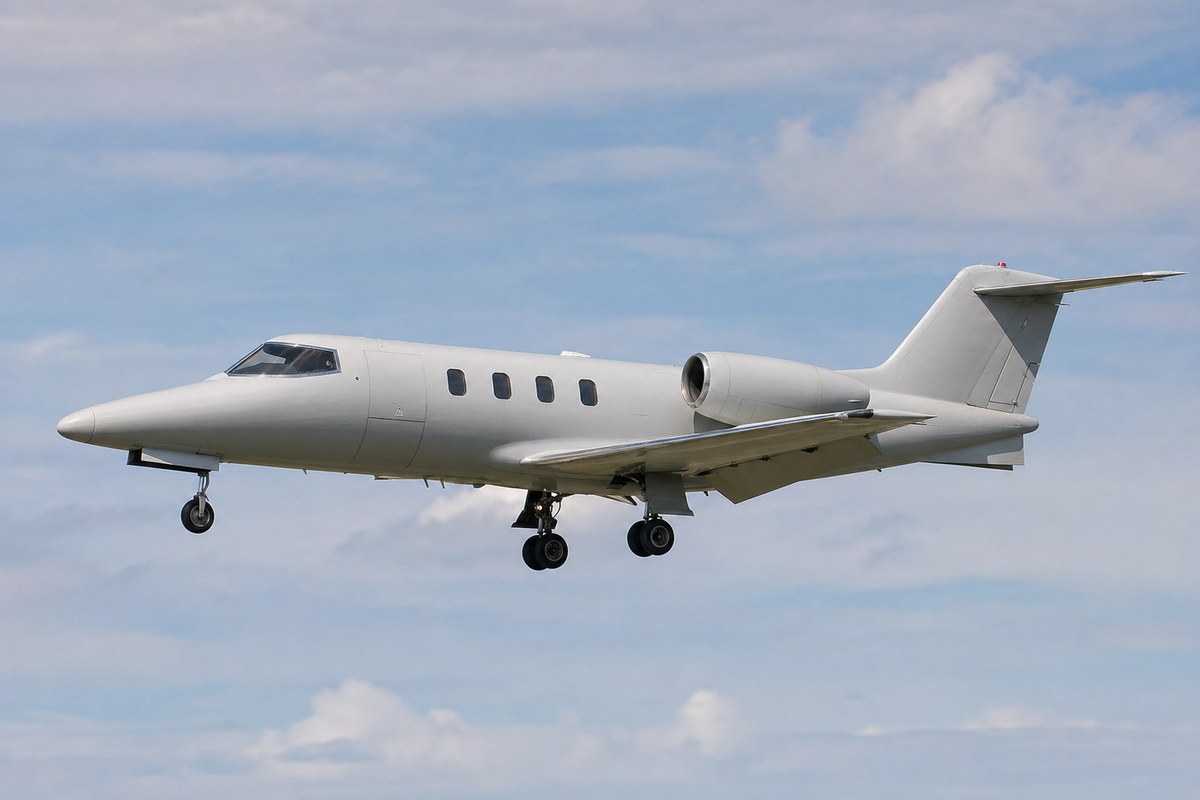
The program originated from Bill Lear's adaptation of the FFA P-16, a Swiss ground-attack jet cancelled after two prototype crashes, first developed in Switzerland before operations moved to Wichita, Kansas. The prototype was destroyed in June 1964 when its spoilers deployed during a simulated engine failure on takeoff. The FAA issued a type certificate in July 1964 on the strength of the second prototype, and the first customer delivery occurred in October 1964 — just over twelve months from first flight to entry into service. The aircraft was certificated under small-airplane rules, placing its maximum weight just under the transport-category threshold, and seated two crew and six passengers in a cabin slightly over four feet in width and height, with a cold-drinks cabinet, a curtained under-seat toilet occupying one passenger position, and a fold-down divan extending into the pressurized baggage bay. Bill Lear's response to complaints about headroom was: "You can't stand up in a Cadillac either."
Executive Jet Aviation — later NetJets — launched operations in 1964 with ten Learjet 23s, marketed to company presidents flying piston twins at a price below competing business jets. The Model 23 was quickly superseded by Lear's own Model 24, built to transport-category standards, and later the stretched Model 25; production of the 23 ended in 1966 at 101 units. Roughly one third of the original fleet was lost in accidents, concentrated among pilots transitioning directly from piston twins to jet speeds. The most notable accident occurred in May 1970, when a chartered Learjet 23 flew into terrain on approach to Pellston, Michigan, killing UAW president Walter Reuther and five others; investigators found the aircraft's altimeter assembled with missing parts, wrong parts, and one component fitted upside down.
At the end of 2015, Stage 3 noise regulations barred non-hush-kitted Learjet 23s from operating in the contiguous United States, and the FAA acknowledged in the rule that no off-the-shelf hush kit exists for the type. Eight surviving examples sit in museums, including the Smithsonian, and a ninth is at a salvage yard in Missouri. In Wichita, volunteers associated with the Classic Lear Jet Foundation, drawn from the former Learjet workforce, acquired the third airframe ever built (serial 003) and had it stripped to bare metal for inspection by 2025. Bombardier transferred primary parts stocking for the oldest Learjets to GlobalParts.aero in 2015; beyond that, supply relies on independent stockists and teardown houses. Airframe maintenance goes to legacy-Learjet specialists — Trine Aerospace in Colorado Springs performed the flyable example's lettered checks and 12-year inspection — and the CJ610 turbojets are supported by a small network of authorized shops, with lease-pool engines commonly used during extended shop visits. PlanePhD's safety study recorded no fatal Learjet 23 accidents in the 2005–2024 window, and the estimated cost of ownership is approximately $399,100 per year, or $3,991 per flight hour at 100 hours annually.
Industry impact & what to watch
The Learjet 23's arc — a fast-selling breakthrough design overtaken within two years by its own manufacturer's next model — is the pattern that defines the earliest generation of business jets: rapid technical iteration left first-generation types with short production runs and thin surviving fleets decades later. What keeps a type like this airworthy has nothing to do with OEM backing; Bombardier's 2015 handoff of parts stocking to GlobalParts.aero effectively ended factory involvement, and everything since — independent teardown houses, specialist shops like Trine Aerospace, lease-pool engines, and volunteer labor from former Learjet employees — is what substitutes for it.
This is how legacy-fleet economics generally work once a manufacturer exits: airworthiness becomes a function of parts availability and specialist labor rather than OEM support, and a fleet's size can collapse from over a hundred units to a single flyable example without the type disappearing from view, since museum placement and restoration projects preserve the airframes even as operational numbers fall to near zero. The absence of a hush kit — acknowledged by the FAA itself in the Stage 3 rule — shows how a regulatory deadline can retire an entire fleet from a market at a stroke, regardless of individual airframe condition.
What happens to the Wichita restoration project, serial 003, as it moves from stripped bare metal toward a return to flying status, is the next concrete marker for whether this type's flyable population can grow beyond one.