Two Pilots Fly Cirrus SR22 to Remote East Greenland for 2026 Solar Eclipse
Why It MattersLong-range single-engine flights into fuel-scarce, radio-shadowed regions depend on advance ground logistics and relay communications rather than aircraft range alone.
What happened
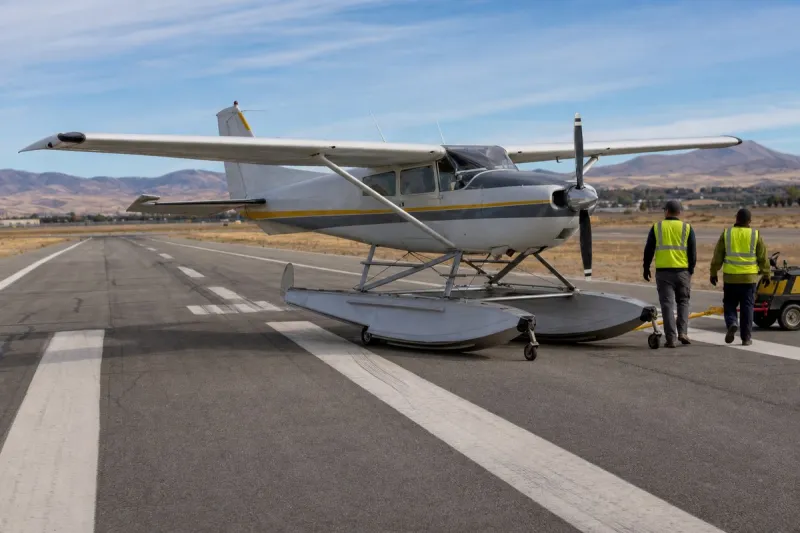
Bart Gray and a co-pilot departed Brooksville, Florida (KBKV) on August 6, 2026, flying a 2011 normally aspirated Cirrus SR22 G3, registration N140BV, on an expedition to eastern Greenland timed to the August 12, 2026 total solar eclipse, whose path of totality passed directly over their primary destination. The aircraft carried no auxiliary fuel tanks, no HF radio, and no ferry modifications.

Cruising between 10,000 and 12,000 feet, lean-of-peak settings at 12,000 feet and an OAT of -10°C produced a fuel flow of 10.7 gph, 52% power, and a true airspeed of 158 knots, giving 7.5 hours of endurance. Most legs ranged from 600 to over 800 miles; the opening leg from Brooksville to Bethel, Maine (0B1) covered 1,107 miles. The crew wore immersion suits over wool long underwear and carried survival gear as required by the Greenland AIP.
Their primary destination was Ittoqqortoormiit, a community of approximately 350 residents on Greenland's eastern coast in the Scoresby Sund region, widely regarded as one of the most isolated communities on Earth. Nerlerit Inaat Airport, also known as Constable Point (BGCO), serves the village and lies about 21 miles northwest of it, with a 3,281-foot hard-packed gravel runway and a GPS approach procedure. Because BGCO does not stock 100LL avgas, the pilots arranged through airport gift shop manager Morten Mandrup to import four drums of fuel shipped from Norway, delivered by the single annual supply vessel that reaches the fjord after sea ice breaks up, typically around the beginning of August.
The crossing from Kangerlussuaq (BGSF) to Constable Point covered approximately 642 miles, flown at 11,500 feet MSL, roughly 1,500 feet above the Greenland Ice Sheet. VHF contact with Sondrestrom Radio was lost about 90 miles east of Kangerlussuaq; for more than four hours the crew flew with virtually no direct communication. An American Airlines flight overhead relayed a position report and provided the current weather at Constable Point. The route also passed over the southern portion of Greenland National Park, the world's largest national park at 375,000 square miles.
In Ittoqqortoormiit the pilots stayed at the Ittoqqortoormiit Guest House, a communal facility with fjord views. The village has no restaurants, hotels, taxis, or rental cars. One morning, a crew member encountered local Inuit residents on a patrol to check for polar bears near the school route, a routine precaution in a community where polar bears occasionally enter the town.
Fuel logistics and the timing window
The expedition's schedule was set not by the eclipse alone but by the annual supply vessel that brings fuel to Constable Point once sea ice clears the fjord, a window that typically opens around the beginning of August. Arranging four drums of avgas from Norway through a local gift shop manager was the mechanism that made a light single-engine piston aircraft viable at an airport with no avgas stock of its own.
The four-hour communication gap west of Kangerlussuaq, bridged only by a passing American Airlines flight relaying position and weather, shows how thin the safety net becomes once an aircraft without HF radio moves beyond VHF range over the ice sheet.
Industry impact & what to watch
This flight belongs to a category of long-range light-aircraft operations where the limiting factor is not airframe range but ground infrastructure: fuel availability, radio coverage, and survival equipment requirements set by the destination's own aviation authority. A normally aspirated single with no ferry tanks reached Greenland only because a local contact could import avgas ahead of the trip.
In this segment, endurance calculations (fuel flow, power setting, true airspeed) matter less than whether fuel and communication support exist at the far end of each leg. The four-hour loss of VHF contact over the Greenland Ice Sheet illustrates how operators flying outside normal air-traffic coverage rely on passing airline traffic or pre-arranged relay procedures rather than continuous ATC contact.
What remains to be seen is whether this kind of eclipse-driven or destination-driven expedition into isolated Arctic airports becomes a repeatable pattern for other private pilots, or stays a one-off shaped by the particular timing of ice breakup, fuel imports, and a rare celestial event.