Antonov An-124 Carries 102-Tonne Generator Rotor From Stuttgart to Malaysia in Chapman Freeborn Charter
Why It MattersOutsize cargo charters show that heavy-lift capacity is decided by aircraft payload margins, fuel limits, weather and airspace constraints together, and that air freight wins when idle plant outweighs transport cost.
What happened
Aircraft charter specialist Chapman Freeborn has announced its involvement in an Antonov An-124 charter from Stuttgart, Germany, to Malaysia in July 2026. The aircraft carried a powerplant generator rotor and its transport frame, with a total cargo weight of 226,739 lb (102,847 kg). The route required five intermediate stops.
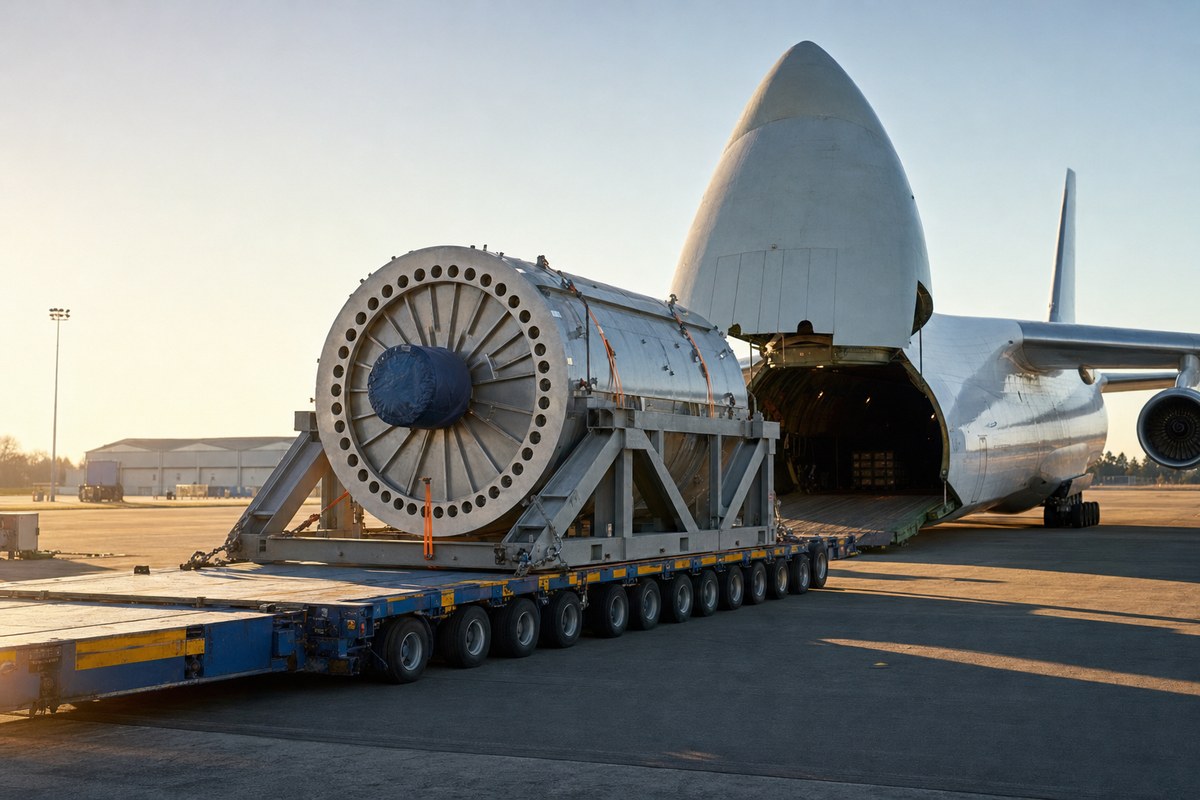
The cargo was a powerplant generator motor from Malaysia that had been undergoing repair work in Germany, along with high-speed balancing in the United Kingdom. Air transportation was needed because the powerplant's generating capacity was out of operation while the motor was away. Even with five stops, the mission was significantly shorter than the two months each way required for sea freight. Anton Lomakin, VP of Cargo Air Chartering (ASEAN) at Chapman Freeborn, commented on the operation, saying the challenge with a shipment of this scale is not just finding an aircraft capable of carrying the cargo.
A heavy-duty road transporter moved the generator rotor within Europe, and lifting equipment loaded the rotor and its transport frame onto the aircraft on the tarmac in Stuttgart. Ground crews had to position the load carefully so the aircraft's center of gravity was not thrown off balance.
The An-124 has a maximum takeoff weight of 864,000 lb (392,000 kg) and a maximum payload of 264,500 lb (120,000 kg). Its range is 8,900 nautical miles (16,500 km), and it is powered by four ZMKB Progress D-18T turbofans, each producing 51,500 lbf (229 kN).
Because the component was close to the aircraft's maximum payload, the amount of fuel it could carry was limited. Highs in Stuttgart reached 99°F (37°C) on peak summer days, while daytime highs in Malaysia were around 88°F to 95°F (31°C to 35°C) with high humidity, so the An-124 could not fly at its peak performance. The ongoing conflict in the Middle East substantially reduced available routing options, forcing the aircraft to stay well clear of conflict zones and to cross more international borders at each stop.
Industry impact & what to watch
Moves of this kind are priced against downtime, not against the cost of the flight. A powerplant with its generating capacity offline loses more with every week the rotor spends at sea, and a two-month ocean leg each way makes a five-stop airlift the shorter route even when it is operationally awkward. That is the economic logic that keeps very large aircraft in demand for single, irreplaceable components.
The operation also shows how heavy-lift planning actually works. Payload headroom is only one input: a load near the 120,000 kg maximum constrains fuel, hot-day performance trims it further, and every added border crossing or rerouted leg adds permits and handling. When conflict removes airspace, the number of stops and the fuel plan are set by the same few variables, so a charter broker's value lies in solving them together rather than in locating an aircraft.
For the next such mission, the useful milestones are the same ones this flight had to clear: confirmation of the aircraft's performance on the departure-day temperature, a stop plan that fits the fuel limit, and clearances for each border. Which of those becomes the binding constraint is likely to vary with season and with the state of regional airspace.