FAA Counts 11,027 Certified Controllers, but Most of the Staffing Gap's Shrinkage Came From a Lower Target
Why It MattersA gap narrowed mainly by lowering the staffing target, with certification taking over two years per hire, means headline controller counts overstate how much usable capacity the system has actually gained.
What happened
The FAA counted 11,027 certified professional controllers on September 30, 2026, the highest level in a decade, against a target of 12,563, a shortfall of 1,536. About 4,000 more controllers were in the training pipeline as of April 2026, roughly 1,000 of them already certified elsewhere and requalifying after moving to a new facility.
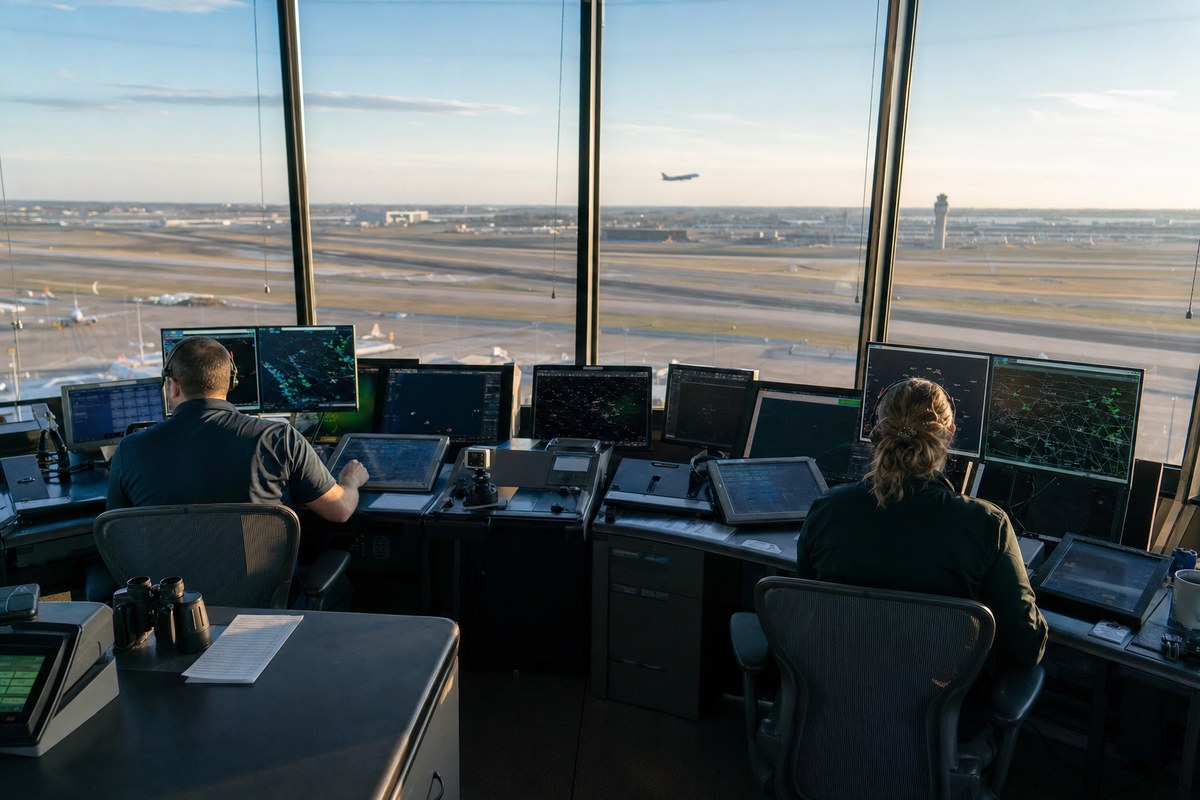
Counting trainees, the agency employs about 15,000. Adding more than 1,500 controllers at 266 privately run contract towers brings the US civilian total to about 16,500. Military controllers are not included, and no published total was found.
The FAA's 2026-2028 workforce plan lists 10,694 certified controllers, 1,001 certified controllers in requalification, 2,529 developmental controllers and 608 FAA Academy students as of September 2025, a total of 14,832. For September 2026 it planned 10,968 certified controllers and a total of 15,321; the actual certified count came in at 11,027.
The FAA hired a record 2,235 trainees in fiscal 2026, yet the certified force grew by 333. The FAA says certifying a new hire can take more than two years, and the plan expects to lose 743 Academy students in fiscal 2026.
How the gap shrank
In September 2024 the FAA had 10,730 certified controllers against a target of 14,633, a gap of 3,903. The gap fell by 2,367 by September 2026, and the target cut of 2,070 accounts for about 87 percent of that improvement.
The FAA says its old model misjudged controller availability for traffic, lowering its availability factor from 2.14 to 1.87 after a National Academies Transportation Research Board review. It also says better scheduling could raise time on position from about four hours to more than five in an eight-hour shift.
Terminal facilities absorbed 1,471 of the 2,070 positions cut: the terminal target fell from 8,966 to 7,495 and the en route target from 5,667 to 5,068. Counting trainees, both types sit above their new targets; counting only certified controllers, both fall short.
Other published figures
Other published figures count different things. The 35,000 on the FAA's Air Traffic Organization page includes technicians, engineers and support staff. The FAA's recruiting page cites more than 14,000, which matches a rounded headcount including trainees.
The Bureau of Labor Statistics reported about 24,000 controller jobs in 2025 and 22,400 in May 2024, counting the occupation across all employers, with a $148,080 median salary. A March 2026 Transportation Department inspector general audit found the contract towers were about 18 percent understaffed in April 2025.
Industry impact & what to watch
The staffing picture depends heavily on which number is quoted. Certified controllers, trainees, contract-tower staff and the wider occupation each yield a different total, and the improvement in the gap owes more to a revised target than to new certified capacity. For the segment, that means a falling shortfall does not by itself signal more controllers able to work traffic unsupervised.
The pipeline arithmetic shows why change is slow. A record 2,235 hires lifted the certified count by only 333 in a year, because certification takes over two years and attrition, including the 743 Academy students the plan expects to lose, absorbs part of each cohort.
The FAA's availability factor of 1.87 and its scheduling assumptions now carry much of the weight. Whether time on position actually rises from about four hours to more than five in an eight-hour shift, and how trainees are credited under the measure the agency says it will adopt, will show whether the lower target holds up in daily operations.