FAA Proposes Amending Airways V-44, V-170 and V-312 Ahead of Andrews VORTAC Decommissioning
Why It MattersRemoving VOR airway segments as ground stations retire shows the en-route system shifting from conventional navigation toward PBN structure, with remaining low-altitude coverage and RNAV capability increasingly determining which routings stay usable.
What happened
The FAA has issued a notice of proposed rulemaking to amend domestic VOR Federal Airways V-44, V-170 and V-312 in the eastern United States. The proposal follows the agency's plan to decommission the Andrews, MD (ADW), VORTAC on August 5, 2027, part of an effort to reduce dependence on ground-based navigation facilities and legacy en-route structure as the National Airspace System moves toward Performance Based Navigation routes.

The FAA says the remaining ground-based NAVAID coverage in the area would be insufficient to keep the affected routes continuous, so the portions lacking coverage would be removed. For V-44, the segment between the Martinsburg, WV (MRB), VORTAC and the intersection of the Baltimore (BAL) VORTAC 122° and Sea Isle, NJ (SIE), VORTAC 267° radials would be removed. As amended, V-44 would run between the Columbia, MO (COU), VOR/DME and the Centralia VORTAC; between the Parkersburg VOR/DME and the Martinsburg VORTAC; and between the Sea Isle VORTAC and the Albany VORTAC.
For V-170, the segment between the intersection of the Dupont, DE (DQO), VORTAC 223° and Andrews VORTAC 060° radials and the intersection of the Andrews VORTAC 060° and Baltimore VORTAC 165° radials would be removed. As amended, V-170 would run between the Jamestown, ND (JMS), VOR/DME and the Badger, WI (BAE), VOR/DME, and between the Slate Run, PA (SLT), VORTAC and the Dupont VORTAC.
For V-312, the segment between the intersection of the Andrews VORTAC 060° and Baltimore VORTAC 165° radials and the intersection of the Andrews VORTAC 060° and Woodstown, NJ (ODD), VORTAC 230° radials would be removed. As amended, V-312 would run between the Woodstown VORTAC and the intersection of the Coyle, NJ (CYN), VORTAC 090° and Kennedy, NY (JFK), VOR/DME 154° radials.
Alternatives and compliance cost
The FAA says IFR traffic could use adjacent airways V-33, V-93, V-123, V-166, V-268, V-378, V-379 and V-499, or receive ATC radar vectors. RNAV-equipped aircraft could use adjacent routes T-224, T-287, T-291, T-295, T-307, T-315, T-320, T-335, T-356, T-358, T-447 and T-476, or fly point-to-point using the remaining waypoints.
The agency expects at most de minimis compliance costs or minor rerouting, and has certified that the rule would not significantly affect a substantial number of small entities. Comments are invited under docket 26-AEA-12 through the Federal eRulemaking Portal.
Industry impact & what to watch
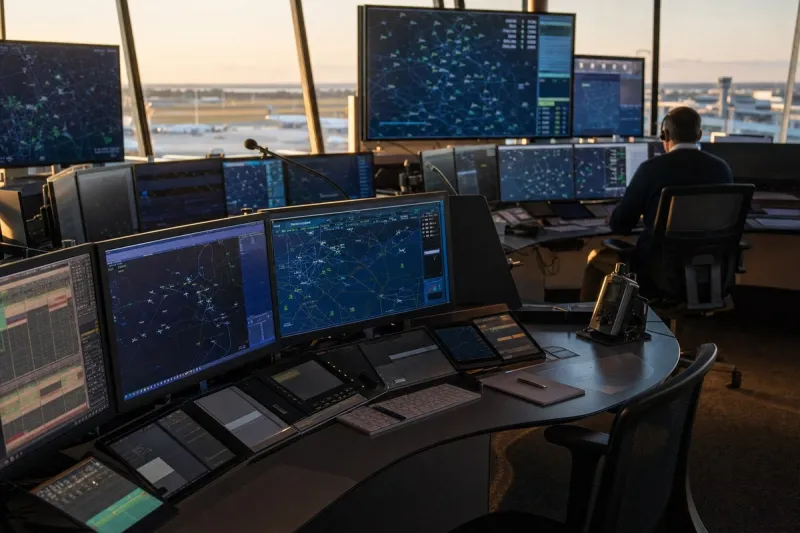
Pruning VOR airways around a retiring station is one small instance of a wider restructuring: conventional routes are being cut back wherever ground-based coverage can no longer sustain them, and the route network is being rebuilt around PBN. For flight departments and charter operators working the Washington–Baltimore–New York corridor, the practical dividing line is between aircraft with RNAV capability, which can use T-routes or direct waypoint routings, and aircraft relying on conventional VOR navigation, which fall back on remaining airways or radar vectors.
Vectoring as a stated alternative also means more reliance on controller workload in a congested part of the airspace, a factor that tends to show up as routing variability rather than as a formal restriction.
The next milestones are the closing of the comment period under docket 26-AEA-12 and any final rule that follows, ahead of the August 5, 2027 decommissioning date.