Review Documents Advances in Active Flow Control for Rudderless Aircraft
Why It MattersFlow-control flight has moved from lab demonstrations toward full-scale demonstrators, shifting the stealth-versus-control trade-off in flying wing design from hinged surfaces toward fluidic actuation and the supply systems behind it.
What happened
A research review published in Advances in Aerodynamics documents the progress of active flow control aircraft, tracking engineering milestones that remove conventional mechanical rudders and expand short takeoff and landing capability. The review cites the National Aeronautics and Space Administration's definition: active flow control introduces energy directly into the boundary layer on demand to manipulate local aerodynamic phenomena, so that modest localized fluid inputs can produce dominant effects across an entire airframe.
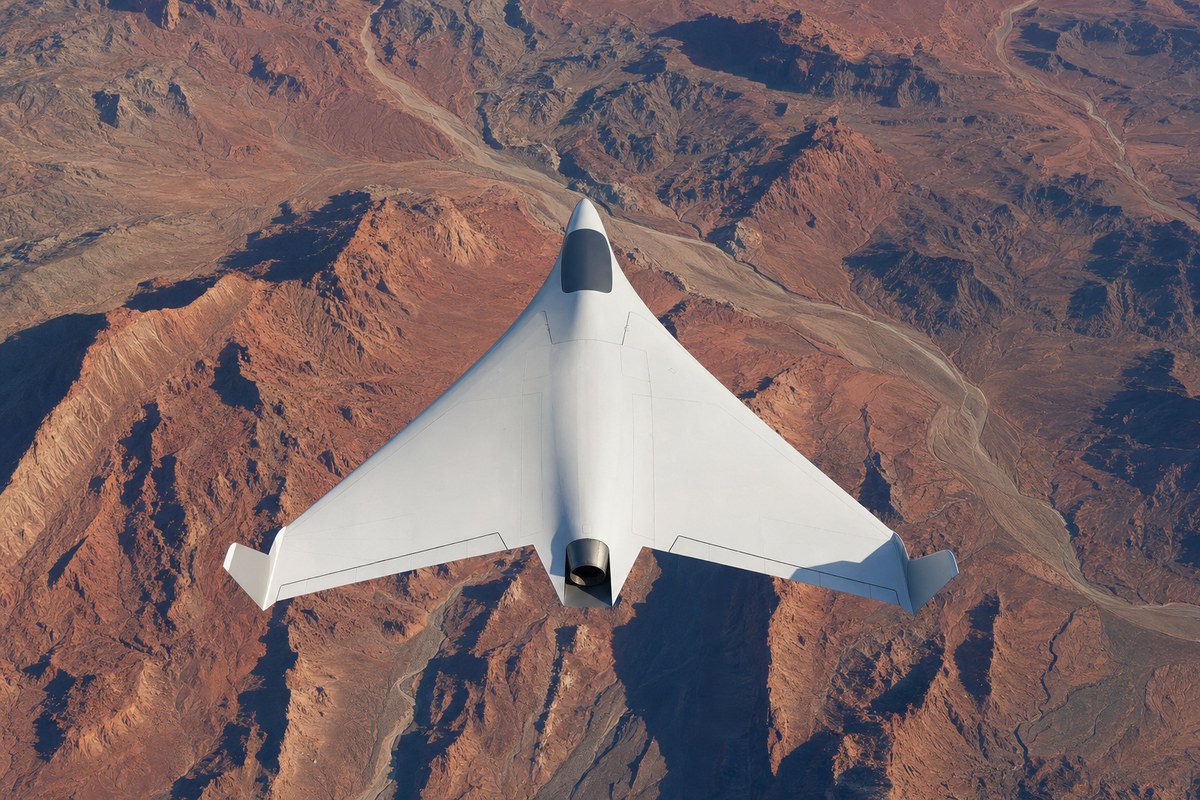
The review describes conventional hinged rudders as a burden on flying wing aircraft, the main platforms for rudderless control work. They add structural weight, require voluminous internal mechanical assemblies, create maintenance complexity and introduce nonlinear responses such as actuator saturation and mechanical dead zones. In low-observable configurations, heading control sets stability against stealth, because radar cross-section requirements demand minimal surface deflection.
Early systematic work came from European and NATO initiatives. In 2004, BAE Systems and ten academic institutions launched the Flapless Air Vehicle Integrated Industry Research program alongside the AEROMEMS II consortium. University of Manchester flight experiments began in 2005 with the Tutor40 unmanned aerial vehicle, which used outer-wing circulation control for roll. In 2006 the Vector II platform demonstrated pitch control through co-flow fluidic thrust vectoring, and in September 2010 the ninety-kilogram DEMON unmanned aerial vehicle flew.
Under the NATO Science and Technology Organization Applied Vehicle Technology program, phases AVT-168, AVT-215, AVT-239 and AVT-295 examined virtual aerodynamic shaping, boundary layer blowing and flow-effector integration across the Innovative Control Effectors and stability and control configuration airframes. Evaluations completed in 2019 found that replacing mechanical rudders with active flow control actuators cut internal volume by ten percent and component weight by twenty-five percent. A subscale ICE vehicle flew in August 2018.
The subscale MAGMA demonstrator, developed by BAE Systems and the University of Manchester, flew baseline tests with conventional mechanical surfaces in 2017. In April 2019 it achieved pure active flow control roll and pitch manipulation without any moving control surfaces. Roll was governed by compact trailing-edge circulation slots; pitch authority came from blowing engine compressor bleed air through an internal spanwise nozzle array downstream of a backward-facing step designed to eliminate hysteresis and bi-stable flow switching.
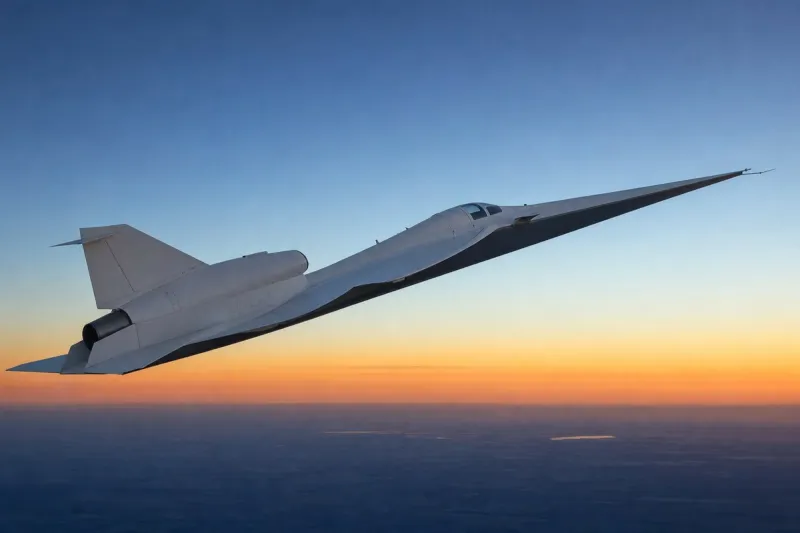
In the United States, the Defense Advanced Research Projects Agency began the Control of Revolutionary Aircraft with Novel Effectors program in 2020 to build active flow control into aircraft conceptual design instead of retrofitting actuators onto existing airframes. Aurora Flight Sciences, Lockheed Martin, Georgia Tech and BAE Systems took part in the multi-phase effort. The demonstrator was designated the X-65 in May 2023, and Aurora Flight Sciences was commissioned in January 2024 to build the full-scale flight article.
Chinese institutions contributed across several actuation methods. Nanjing University of Aeronautics and Astronautics validated circulation control roll authority on conventional airframes in 2014, then flew a fully tailless canard unmanned airframe in 2015 and a three-axis rudderless flying wing in 2019. A thrust-vectoring design using passive secondary flow induction reduced tactical turning radii by eighty percent and raised pitch acceleration by 143.6 percent in 2015 flight tests by Cao and colleagues.
The National University of Defense Technology pioneered zero-mass-flux dual synthetic jet actuators, which operate without external air bottles, compressor bleed lines or heavy mechanical valves. Between 2021 and 2023, researchers integrated them across the AFC-1, the multi-axis AFC-2, the AFC-3 and the turbojet-powered AFC-4 flying wing. The AFC-4 achieved complete three-axis rudderless flight control at a cruise velocity of seventy meters per second and Mach 0.2, the fastest published active flow control flight velocity to date.
Industry impact & what to watch
The programs in the review share a design logic: removing hinged surfaces frees internal volume and cuts component weight, and in low-observable flying wings it also removes the conflict between control authority and radar signature. The reported ten percent volume and twenty-five percent component weight reductions are the clearest quantified case for that trade, and they come from subscale and evaluation work rather than from a fielded aircraft.
The review also shows two supply routes for the control energy. Bleed-air systems such as MAGMA draw on engine compressor air, which ties flow control to the propulsion system. Zero-mass-flux synthetic jets, as flown on the AFC series, avoid air bottles, bleed lines and heavy valves, which makes them easier to package on small airframes. Which route scales to larger aircraft is the engineering question the field has not yet settled.
The next concrete milestone is the full-scale X-65 flight article that Aurora Flight Sciences was commissioned to build in January 2024. Flight results from that aircraft would test whether fluidic control carries over from subscale unmanned vehicles to a larger airframe designed around it from the start.