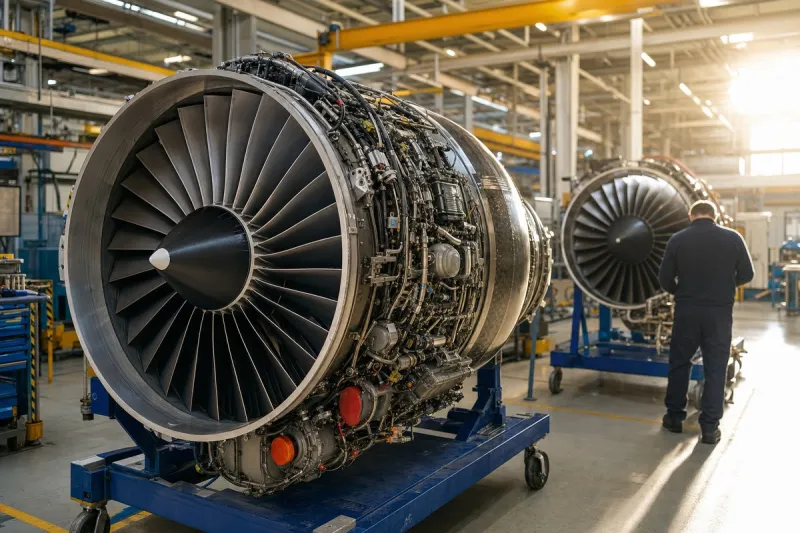
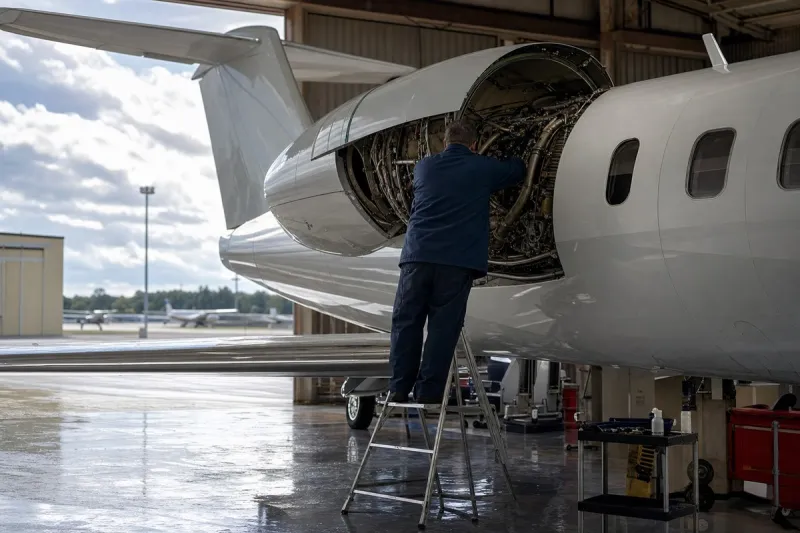
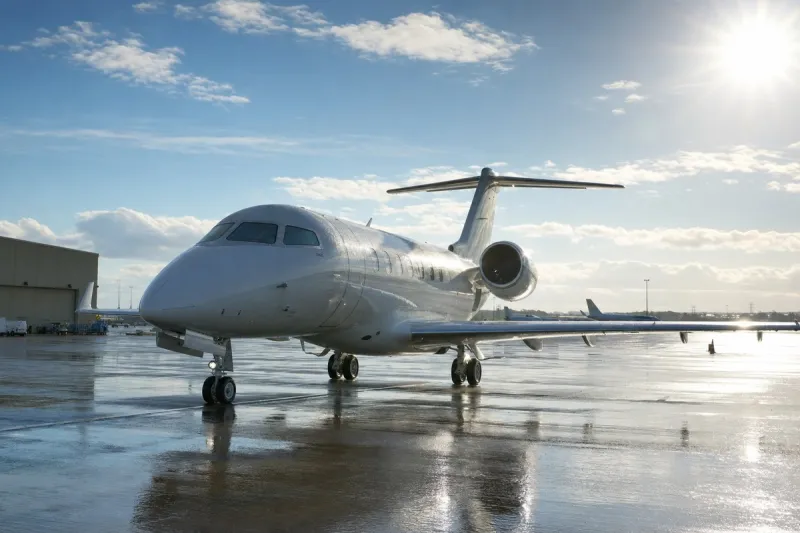
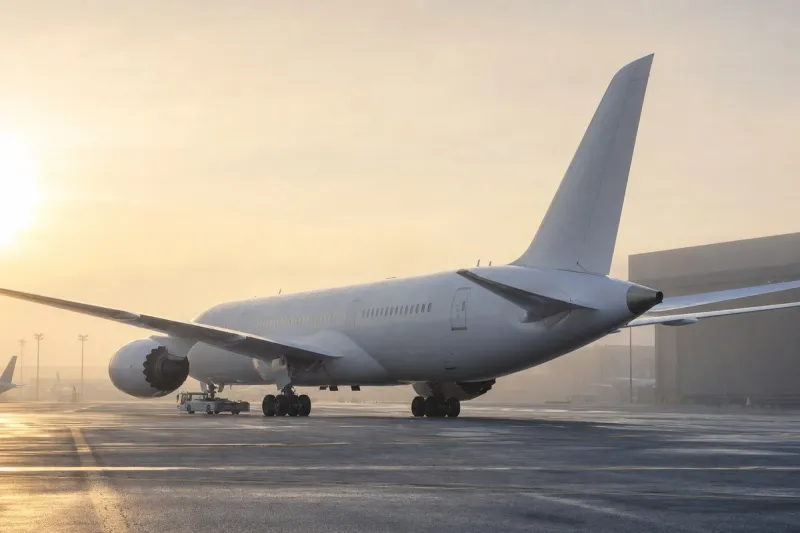
GE Aerospace Leads $170.3B Jet Engine Market in 2026, Four Manufacturers Supply 99% of Global Demand
Why It MattersWide margin gaps between the four dominant engine makers show that servicing and backlog execution, not market share, now determine profitability across the propulsion supply base.
What happened
The global aircraft engine market is estimated at approximately USD 170.3 billion in 2026, up from USD 161.6 billion in 2025, and is forecast to reach USD 248 billion by 2034 at a compound annual growth rate of 4.8%, according to third-party market estimates. Four manufacturers — GE Aerospace, Pratt & Whitney (a division of RTX), Rolls-Royce, and Safran — collectively supply approximately 99% of commercial and military aircraft engines, and all four raised full-year guidance during 2025 and the first half of 2026.
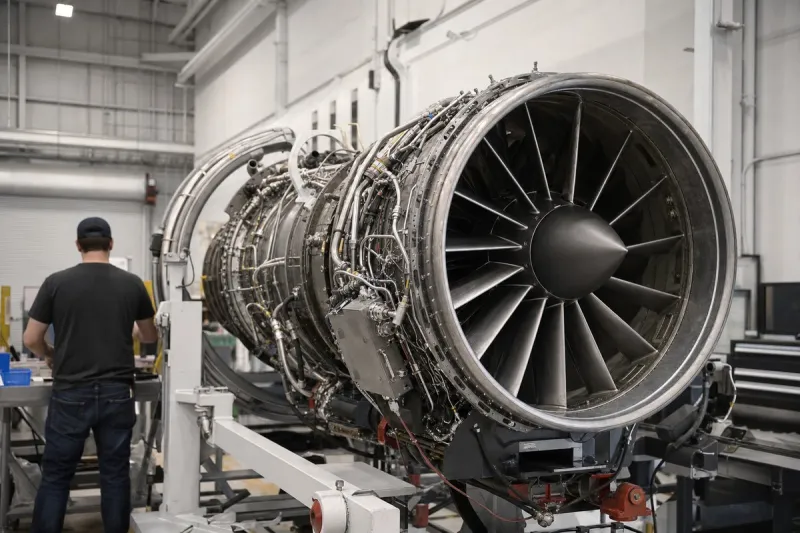
GE Aerospace leads by revenue, reporting USD 45.9 billion in FY2025, up 18% year on year, with USD 43.9 billion generated by its two propulsion segments. The company holds an installed base of approximately 50,000 commercial engines and a remaining performance obligation exceeding USD 210 billion at mid-2026, of which USD 169.8 billion sat within its Commercial Engines & Services segment. Pratt & Whitney ranked second at USD 32.9 billion in FY2025 revenue, up 17%, with its geared turbofan (GTF) engine installed on more than 2,600 aircraft. GE Aerospace and Safran jointly own CFM International, a 50/50 joint venture manufacturing the LEAP and CFM56 engine families; CFM powers close to three out of every four commercial flights, and each parent consolidates 50% of CFM International's activity.
Operating margins diverged in the first half of 2026. GE Aerospace's Commercial Engines & Services segment recorded an operating margin of 27.3% in Q2 2026. Rolls-Royce reported a Civil Aerospace margin of 25.3% in H1 2026, compared with 16.6% in FY2024. Safran's Propulsion division recorded a recurring operating margin of 24.5% in H1 2026 on 27.7% organic growth. Pratt & Whitney recorded 8.3% in Q2 2026, reflecting ongoing remediation of a metallurgical defect identified in 2023 and costs associated with ramping a young fleet.
Order backlogs remain large relative to annual revenue. RTX reported a total company backlog of USD 289 billion at mid-2026, comprising USD 170 billion of commercial and USD 119 billion of defence work, with Pratt & Whitney accounting for USD 151 billion at the close of FY2025. Of GE Aerospace's FY2025 backlog, USD 163.0 billion represented services and USD 27.5 billion represented equipment, while Rolls-Royce's large engine order book stood at 2,266 engines at 30 June 2026. Asia-Pacific is the largest regional segment at approximately 33.4% of the 2026 market: in July 2026 IndiGo ordered more than 1,000 LEAP-1A engines to power over 510 Airbus A320-family aircraft, in May 2026 AirAsia confirmed an order for 150 Airbus A220 aircraft powered exclusively by Pratt & Whitney GTF engines, and lessor Avolon contracted for 100 CFM LEAP engines during 2025. In the narrowbody segment, the Boeing 737 MAX is offered exclusively with the LEAP-1B, while the Airbus A320neo family offers a choice between the LEAP-1A and the PW1100G.
Industry impact & what to watch
The four-way concentration at roughly 99% of supply means the commercial engine business behaves less like a competitive market and more like a set of parallel franchises tied to specific airframes — LEAP-1B exclusive on the 737 MAX, GTF and LEAP-1A splitting the A320neo, GTF exclusive on the A220. Once an airline commits to an airframe, its engine choice is often already made, which is why order volumes concentrate around aircraft campaigns like IndiGo's LEAP-1A order and AirAsia's GTF-powered A220s rather than head-to-head engine competitions.
The margin spread between 27.3% at GE Aerospace's commercial segment and 8.3% at Pratt & Whitney shows that in this segment, installed-base scale and services revenue — not engine sales alone — drive profitability, since aftermarket work on a large, mature fleet compounds while a young or remediation-burdened fleet consumes cash before it pays back. Rolls-Royce's improvement from 16.6% in FY2024 to 25.3% in H1 2026 illustrates how quickly margins can move once a manufacturer works through legacy costs, while Pratt & Whitney's figure shows the opposite drag from an unresolved metallurgical issue first identified in 2023.
With backlogs measured in hundreds of billions of dollars against annual revenues in the tens of billions, near-term deliveries are effectively pre-sold, so the segment's real swing factor is execution — how fast RTX resolves Pratt & Whitney's remediation, how Rolls-Royce sustains its margin gains, and how the next-generation open rotor, hybrid-electric and ceramic matrix composite programs each manufacturer is funding for the 2030s eventually reset the competitive lines drawn today.