Menzies Aviation Plans Gulf and US Expansion, Eyes Syria Market Despite Iran War Disruptions
Why It MattersWhen a conflict compresses regional carrier profitability, ground-handling contracts and workforce commitments still hinge on which markets keep growing rather than on the crisis itself.
What happened
Menzies Aviation is pursuing expansion in the UAE, Saudi Arabia and the United States while also assessing opportunities in Syria, chief executive Hassan El-Houry told The National, even as the Iran war raises costs and disrupts travel across the Middle East. El-Houry described Saudi Arabia as a "very fast-growing, large, dynamic" market and said the company wants to serve airports in the UAE and Saudi Arabia. Kuwait is a potential future market after Menzies concluded operations at Kuwait International Airport when its contract expired in January; the company already operates in Iraq, Jordan and Egypt.
On Syria, El-Houry said the company is interested but needs to examine the economics and legalities of the market. Syria's civil aviation sector may attract new foreign investment after the United States removed the country from its list of state sponsors of terrorism last month, ending a 47-year designation. The US expansion builds on Menzies' $305 million acquisition of Texas-based G2 Secure Staff, completed in August 2025. Parent company Agility, which is UAE-based, provides ground handling, fuelling, cargo and lounge services at nearly 350 airports in 65 countries, including London Heathrow and Hartsfield-Jackson Atlanta International Airport.
Menzies reported a 31 per cent year-on-year increase in second-quarter revenue to $908 million, driven by the G2 contribution, new contract wins and better yield. El-Houry said Gulf carriers have restored their route networks to about 90 per cent of pre-war levels. Menzies employs 65,000 people, and El-Houry said the company is continuing to hire and is not reducing its workforce, adding that it has no plans to exit any airport because of the current crisis, though markets such as Africa and Australia have been harder hit than North America and Europe.
Cost pressure across the industry
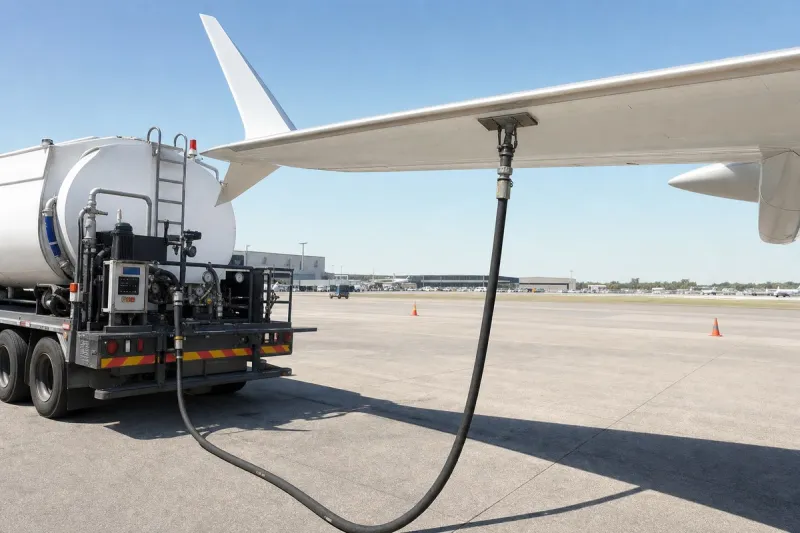
The six-month Iran war has pushed jet fuel costs sharply higher, complicating airline planning. The global aviation industry is on track to earn only about half the collective profit previously forecast for this year, according to IATA's June outlook, and cost-conscious airlines are cutting unprofitable routes, renegotiating supplier contracts and demanding greater efficiency from service providers.
The conflict is also slowing aviation's transition to sustainable aviation fuels, as airlines prioritise conventional fuel security over long-term decarbonisation investments. IATA said SAF production is expected to reach around 2.4 million tonnes in 2026, representing just 0.8 per cent of aviation fuel use, at a cost of $4.3 billion. Airlines pledged in 2020 to reach net-zero by 2050, with SAF meant to supply 65 per cent of the carbon reductions needed.
Industry impact & what to watch
Menzies' expansion push during an active regional conflict shows how ground handlers can decouple their growth decisions from airline-level financial stress, so long as the underlying market — new airport contracts, population growth, government investment — keeps expanding. A handler's revenue depends less on how any single carrier is performing than on how many airports it serves and how much traffic moves through them, which is why Menzies can report a 31 per cent revenue jump while airlines above it in the value chain face halved industry profit expectations.
That dynamic also explains the interest in Syria: an operator like Menzies can weigh a market's economics and legalities independent of whether regional airlines are currently profitable, because ground handling revenue follows flight volume and contract wins rather than fuel-cost exposure. The same logic underlies the workforce decision — with 65,000 employees and no stated exit plans, Menzies is treating the Iran war as a cost event for airlines rather than a demand event for handling services, at least in North America and Europe.
What remains open is how long that separation holds if Gulf carriers' route recovery stalls below the current 90 per cent of pre-war levels, and whether harder-hit markets like Africa and Australia start to affect contract renewals there the way they have not yet in Menzies' core regions. Any formal move into Syria, and the terms Menzies eventually sets for it, would be the clearest signal of how the company is pricing the wider regional risk.