Aeromedical experts outline protocols for transporting highly infectious patients by air
Why It MattersThe case shows air ambulance operators standardizing infectious-transport protocols around transmission route, dedicated trained crews and fatigue limits rather than uniform maximum precautions for every case.
What happened
Dr Miguel Cortés, Medical Director at USMX AirLink Air Ambulance, said mission planning for highly contagious patients begins by identifying the route of transmission — contact, droplets, airborne spread, or blood and body fluids — before any PPE is selected. He noted that a patient with Clostridioides difficile or MRSA requires a different strategy than one with pulmonary tuberculosis or influenza, while blood-borne pathogens such as hepatitis B, hepatitis C, or HIV require strict standard precautions and safe sharps handling rather than additional airborne protection.
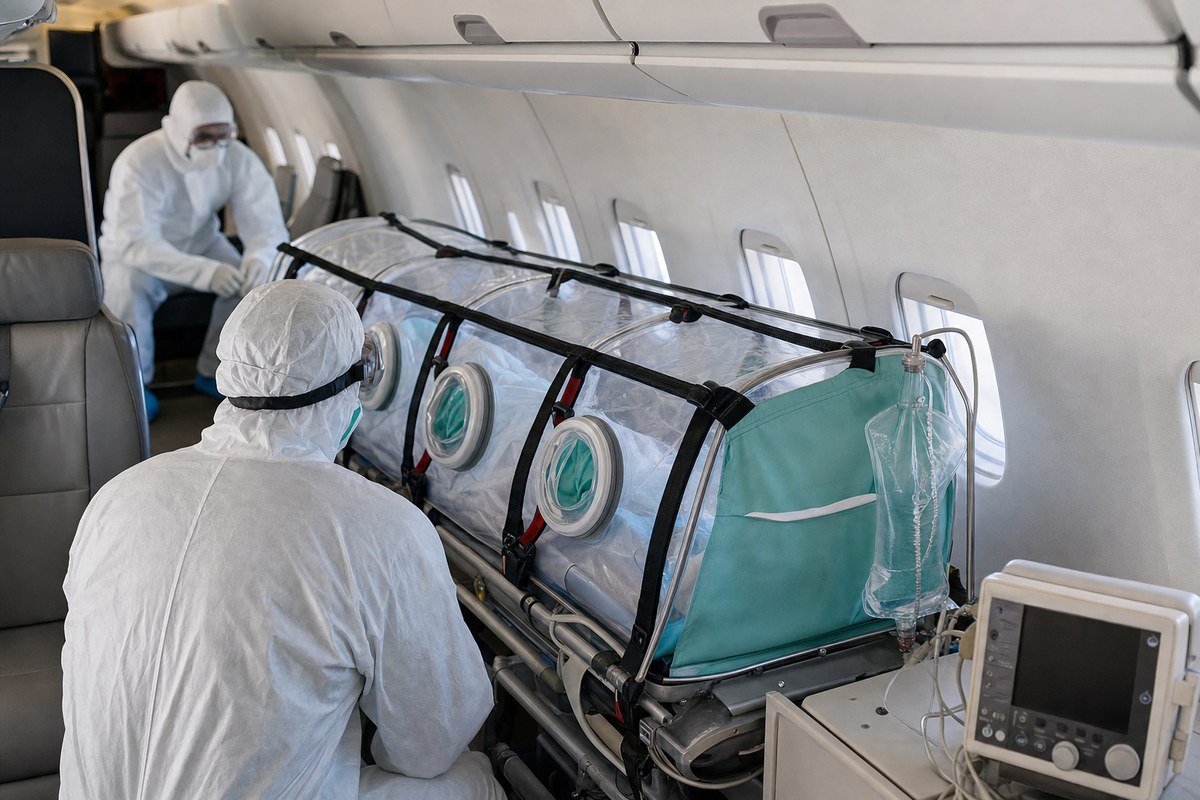
Daniela Wilson, Chief Commercial Officer at Airlec Ambulance, said the company maintains standard operating procedures covering the complete donning and doffing of PPE, with staff receiving annual training on infectious diseases, isolation units, and PPE procedures, and a dedicated voluntary team specifically trained for highly infectious patient transports. Dr Anne-Sophie Ries, Flight Physician and Medical Representative at European Air Ambulance, said EAA also maintains a dedicated high infectious risk team and conducts a minimum of four internal training sessions per year, including simulation exercises, supervised practice, and use of checklists and a trained watchman during PPE donning and doffing.
On crew fatigue, Dr Cortés cited the Covid-19 pandemic, when international missions could require six or more hours in full PPE without removing it, using a restroom, or opening the aircraft door due to local restrictions. He said pre-mission hydration is now part of standard preparation, crews rotate whenever possible, and fatigue is actively monitored during flight. Dr Ries added that defined maximum duty periods and minimum rest requirements apply to every mission, not only those involving infectious patients.
On isolation pods, Dr Ries said their use is now generally reserved for high-consequence infectious diseases such as viral haemorrhagic fevers including Ebola, or for exceptional operational circumstances, while patient masking has become standard practice for suspected airborne or droplet-transmitted infections. Wilson confirmed that for Ebola, transport in an isolation unit or bubble remains mandatory, while recent hantavirus patients were permitted to be transported in an open cabin with masks.
Industry impact & what to watch
This account describes a segment moving from blanket maximum-precaution responses toward transmission-based risk grading, where the pathogen's route of spread — not the mere label of "infectious" — determines PPE, cabin configuration and staffing. Blood-borne pathogens like hepatitis B, hepatitis C and HIV are handled with standard precautions and sharps discipline, while airborne or high-consequence diseases such as Ebola trigger isolation units or masking protocols instead.
Dedicated, separately trained teams at Airlec Ambulance and European Air Ambulance, combined with EAA's minimum of four annual training sessions, show operators building standing infectious-transport capability rather than assembling it ad hoc per mission. Fatigue management — hydration, crew rotation, defined duty and rest periods — is described as embedded in routine mission planning, a discipline both physicians trace to lessons from extended full-PPE Covid-19 missions.
What remains to watch is how individual operators formalize these transmission-based decision trees into checklists that crews can apply consistently across differing regulatory environments, and whether isolation-pod use stays confined to high-consequence pathogens like Ebola as case mix evolves.