Five High-Traffic Single-Runway Airports Where a Closure Severely Disrupts All Operations
Why It MattersWhen land constraints leave a high-volume airport without a spare runway, routine maintenance or a single incident can ripple into system-wide delays that multi-runway hubs simply absorb.
What happened
Five commercial airports handling between 25 million and 45 million passengers annually operate on a single active runway, meaning any closure can immediately halt or severely disrupt all operations. The airports span the United States, China, Portugal and the United Kingdom, with two of them located in the UK alone.
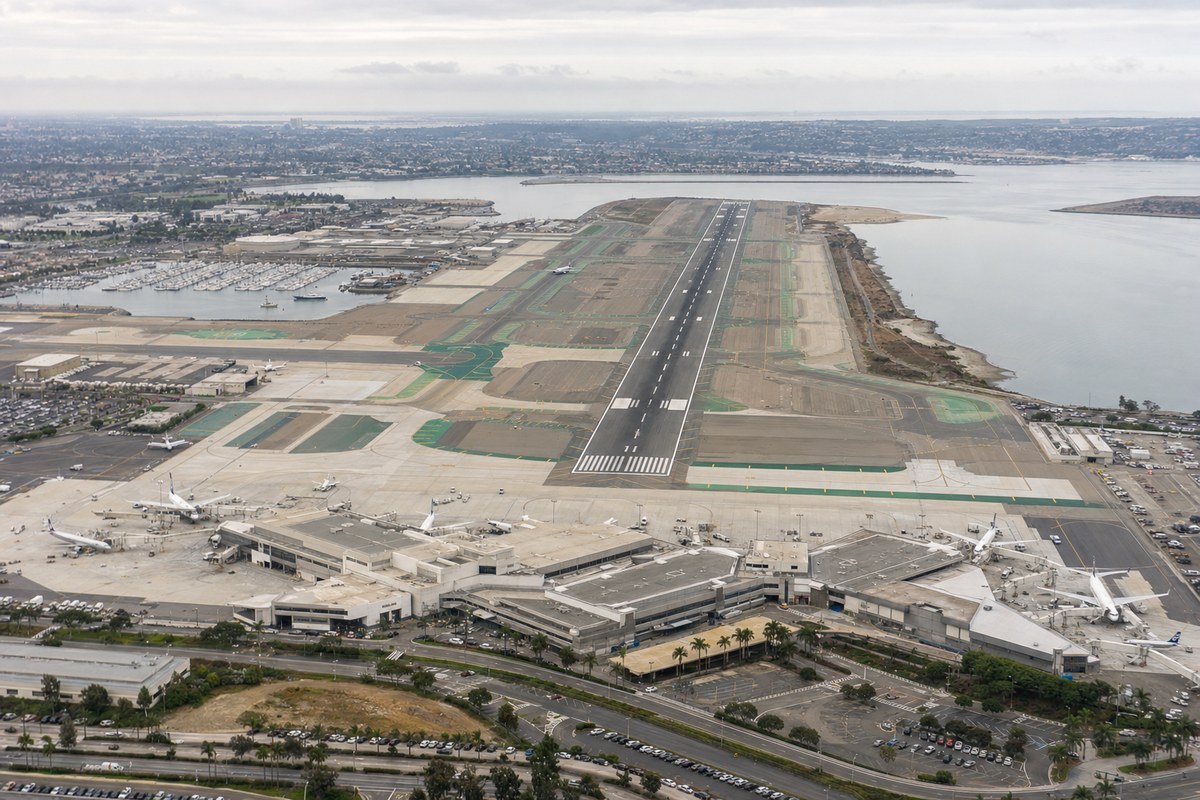
San Diego International Airport (SAN), the busiest single-runway commercial airport in the United States, handled a record 25.24 million passengers in 2024 on runway 09/27, which measures 9,401 feet (2,865 meters). The airport sits 3 miles northwest of downtown San Diego, bounded by San Diego Bay to the south, the Marine Corps Recruit Depot to the north, Interstate 5 to the east, and residential neighborhoods to the west, which prevents any runway addition. Southwest Airlines holds nearly a third of all passengers at SAN, and Alaska Airlines operates a hub there.
Xiamen Gaoqi International Airport (XMN), the busiest single-runway airport in China, recorded 29.19 million passengers and 198,582 aircraft movements in 2025 on its 11,155-foot (3,400-meter) runway. Located on the northeastern tip of Xiamen Island in Fujian Province, about 7.5 miles from central Xiamen, it is surrounded by water, urban development and existing terminal infrastructure, ruling out expansion. It is the main hub for XiamenAir and a focus city for China Eastern Airlines, Shandong Airlines and Spring Airlines, connecting over 100 domestic and international destinations.
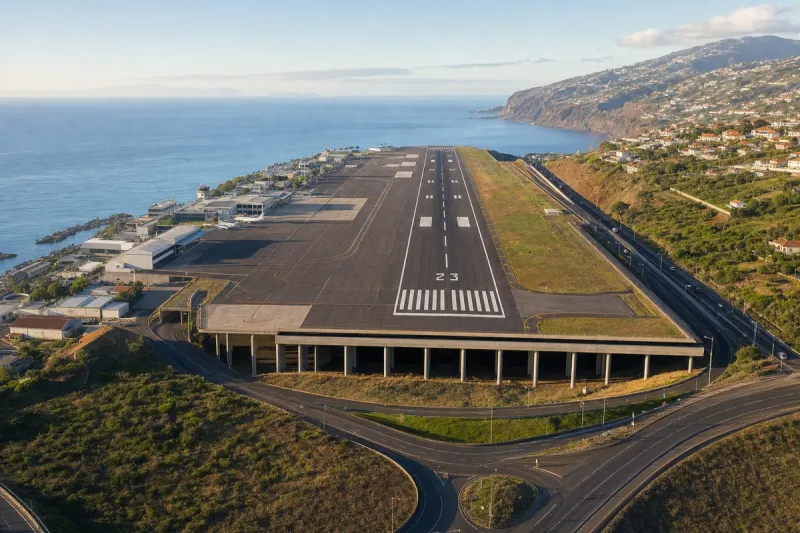
Lisbon Humberto Delgado Airport (LIS), the busiest single-runway airport in mainland Europe, handled 35.1 million passengers in 2024 on runway 03/21, measuring 12,484 feet (3,805 meters), exceeding the airport's designed capacity of approximately 34 million. It is the main hub of TAP Air Portugal and a major base for Ryanair and easyJet. No second airport serves the Lisbon metropolitan area; the nearest alternatives are Porto's Francisco Sá Carneiro Airport (OPO), 190 miles to the north, and Faro Airport (FAO), 165 miles to the south.
London Stansted Airport (STN) handled a record 30 million passengers in 2025 on runway 04/22, measuring 10,000 feet (3,049 meters). It is Ryanair's largest global base, connecting over 150 destinations from the Essex airport located 42 miles northeast of central London; Jet2 and TUI also maintain bases there, and Turkish Airlines launched Istanbul service in March 2026. A £1.1 billion terminal expansion is under way, including a £600 million extension, and in December 2025 Uttlesford District Council approved raising the airport's annual passenger cap from 43 million.
London Gatwick Airport (LGW), the busiest single-runway airport in Europe, handles approximately 280,000 flights and over 45 million passengers per year on main runway 08R/26L, measuring 10,879 feet (3,316 meters). Gatwick has a second runway, the northern standby runway 08L/26R, but it sits too close to the main runway for simultaneous operations and is used only when the main runway is temporarily closed for maintenance or emergencies. Switching from one runway to the other takes approximately 15 minutes, during which no aircraft can land or depart.
Industry impact & what to watch
These five airports illustrate a structural trade-off in aviation: dense urban land, water boundaries or existing built infrastructure can freeze a runway layout in place long after passenger volumes outgrow it. Each case involves a physical barrier — a bay, a coastline, adjacent military or urban land, or terminal buildings — that the airport authority cannot move, so redundancy is engineered out of the system rather than avoided by choice.
Single-runway operation at this scale means schedule resilience depends almost entirely on operational discipline rather than physical backup. Gatwick's standby runway shows the closest thing to a workaround in this group, yet even there a runway switch costs about 15 minutes with no landings or departures, underscoring how thin the margin is even when a second strip technically exists. Lisbon's case is sharper still: traffic already runs above the airport's designed capacity of roughly 34 million, with no substitute airport anywhere in the metropolitan area.
What happens next differs by airport. Stansted's approved increase in its passenger cap and its £1.1 billion terminal expansion signal growth plans layered onto unchanged runway capacity, which puts more weight on how councils and regulators manage slot allocation and delay tolerance. Xiamen's and San Diego's geographic constraints leave little room for a different outcome without a new airport altogether, making their runway capacity effectively a hard ceiling on how much traffic each city can absorb by air.